- LevelIntermediate
- Time4-6 hours
- Hook5.0 mm
- YarnWorsted
About This Pattern
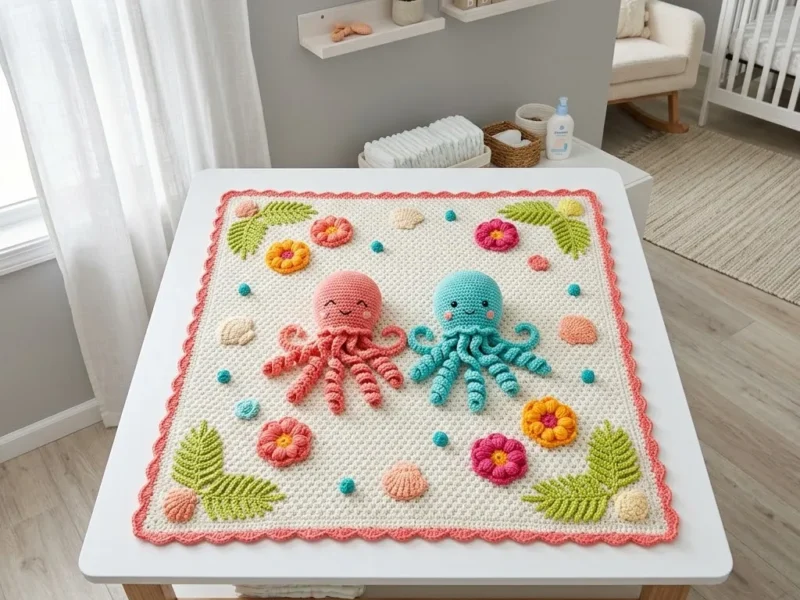
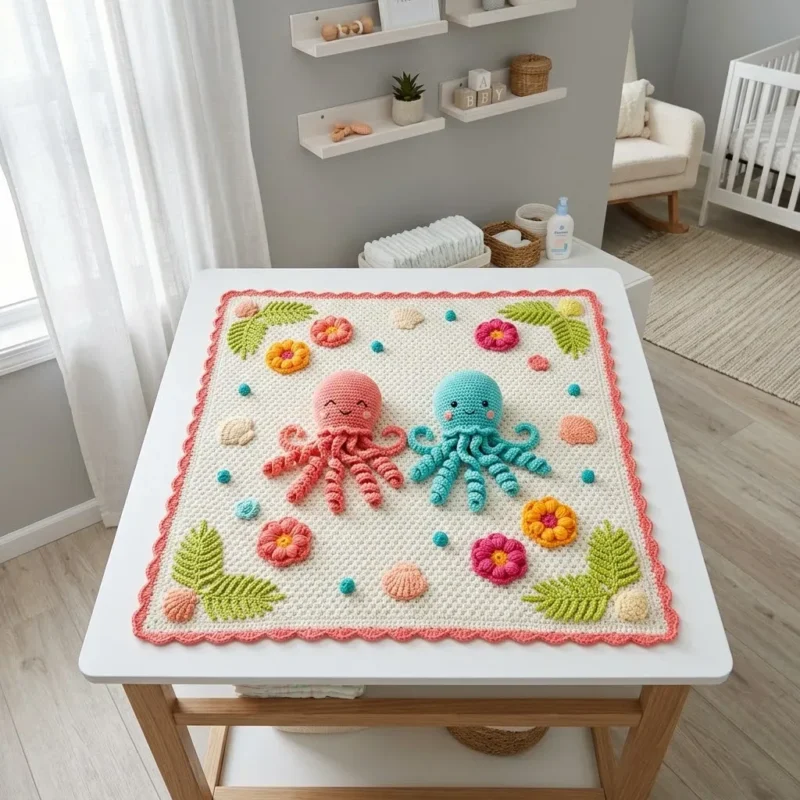
This one feels like a tide pool on a lazy afternoon, cream water with two curious octopus friends floating through it. The filet mesh base gives the whole thing a breezy, open quality before a single appliqué goes on. Once the coral and turquoise shapes land, the mood turns playful without losing that calm, sandy palette.
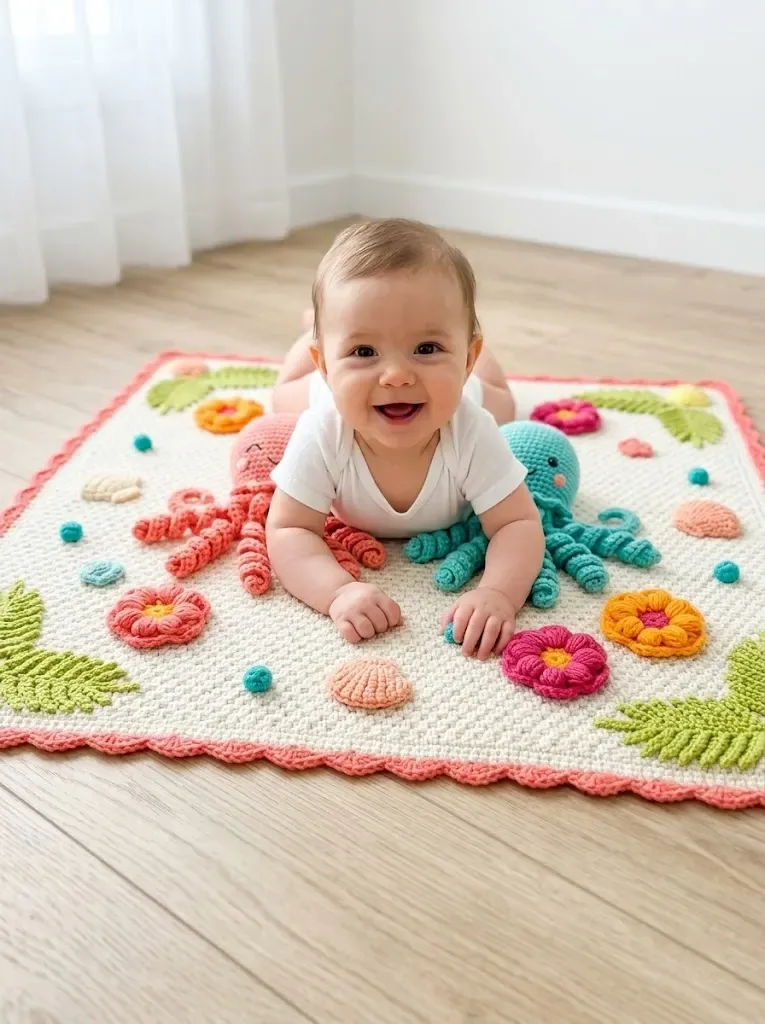
Picture this one draped over the arm of a glider in a nursery, or spread flat on a rug during tummy time. The shell border gives it a finished, boutique edge even though it started as a plain cream rectangle. It is the kind of blanket that gets photographed, then gets used anyway.
- Chain a long foundation row and work the open filet mesh base using the chain-one, skip-one pattern.
- Repeat the alternating filet rows until the cream background reaches the size you want.
- Work the second octopus body in turquoise the same way, so you end up with two distinct creatures.
- Add the leaf, flower, and seashell appliqué pieces in their own colors using the smaller hook.
- Arrange and stitch the octopus bodies and smaller appliqués onto the finished mesh base with a yarn needle.
- Work the border round of single crochet evenly around the whole blanket, tripling stitches at each corner.
- Finish with the shell border round, alternating five-double-crochet shells with single crochet all the way around.
On the desk
- Worsted weight yarn (medium weight, category 4) in the following colors:
- Cream or off-white for the base blanket, approximately 800 yards
- Coral pink for the main octopus and border, approximately 200 yards
- Turquoise or aqua blue for the second octopus, approximately 100 yards
- Lime green for leaves, approximately 150 yards
- Hot pink for flowers, approximately 50 yards
- Golden yellow and orange for flower centers, approximately 30 yards each
- Peach and cream for seashells, approximately 30 yards each
- 5.0mm (H/8) crochet hook for the blanket base
- 4.0mm (G/6) crochet hook for appliqués
- Yarn needle for weaving ends and attaching appliqués
- Scissors
- Polyester fiberfill for stuffing octopus bodies
- With 5.0mm hook and worsted weight yarn:
- Always check your gauge before starting. If your blanket is coming out too small, go up a hook size. Too large? Go down a hook size.
Stitch shorthand
- ch — chain
- st — stitch
- sts — stitches
- sl st — slip stitch
- sc — single crochet
- hdc — half double crochet
- dc — double crochet
- inc — increase
- dec — decrease
- mr — magic ring
- shell — shell stitch
Tropical octopus baby blanket crochet pattern with appliqués
Foundation
With cream yarn and 5.0mm hook:
- Round 1
Ch 107. Sc in second ch from hook and in each ch across. (106 sc)
- Round 2
Ch 1, turn. Sc in first st, *ch 1, skip 1 st, sc in next st* across. (53 sc, 53 ch-1 spaces)
- Round 3
Ch 1, turn. Sc in first sc, *sc in ch-1 space, ch 1, skip sc* across, ending with sc in last sc. (54 sc, 52 ch-1 spaces)
- Round 4
Ch 1, turn. Sc in first sc, *ch 1, skip sc, sc in ch-1 space* across, ending with sc in last sc. (54 sc, 52 ch-1 spaces)Repeat Rows 3 and 4 until blanket measures approximately 28 inches from beginning, ending on an even row.
Final Row: Ch 1, turn. Sc in each st and ch-1 space across. (106 sc)Fasten off and weave in ends.Scalloped Border
The coral scalloped border gives this blanket such a cheerful finished edge. Take your time on the corners.
Join coral yarn in any corner with a sl st.
Part 4
- Round 1
Ch 1, sc evenly around entire blanket, working 3 sc in each corner. Join with sl st to first sc.
- Round 2
Ch 1, sc in same st, *skip 2 sts, 5 dc in next st (shell made), skip 2 sts, sc in next st* around, adjusting as needed at corners to keep the edge flat. Join with sl st to first sc.Fasten off and weave in ends.
If your border is ruffling, you are working too many stitches. If it is pulling in, add more stitches on Round 1.
Coral Octopus Appliqué
This sweet octopus with the happy closed eyes is the star of the show. We will make the head and tentacles separately, then join them together.
Octopus Head With coral yarn and 4.0mm hook, using the magic ring:
Part 5
- Round 1
6 sc in MR, pull tight. (6 sc)
- Round 2
Inc in each st around. (12 sc)
- Round 3
*Sc in next st, inc in next st* around. (18 sc)
- Round 4
*Sc in next 2 sts, inc in next st* around. (24 sc)
- Round 5
*Sc in next 3 sts, inc in next st* around. (30 sc)
- Round 6
through 10: Sc in each st around. (30 sc)
- Round 11
*Sc in next 3 sts, dec* around. (24 sc)
- Round 12
*Sc in next 2 sts, dec* around. (18 sc) Stuff head firmly with fiberfill.
- Round 13
*Sc in next st, dec* around. (12 sc)
- Round 14
Dec around. (6 sc) Fasten off, leaving a long tail. Close remaining hole and set aside.
Octopus Tentacles (Make 8)
With coral yarn and 4.0mm hook:
Ch 25. Starting in second ch from hook: *sc, hdc, dc, dc* repeat this pattern along the chain, curling naturally as you go. The varying heights create the spiral effect.
Fasten off, leaving a tail for attaching.
Attach all 8 tentacles evenly around the bottom of the octopus head, spreading them in a natural arrangement.
Facial Features
Using black yarn, embroider two curved lines for happy closed eyes. Each eye should be about 4 stitches wide, with a gentle downward curve. Add small rosy cheeks using pink yarn if desired.
Turquoise Octopus Appliqué
Make this octopus exactly like the coral one, substituting turquoise yarn. Give this one open eyes by embroidering small circles or using black safety eyes before stuffing (just make sure they are securely attached for baby safety).
Tropical Flower Appliqués (Make 6)
These cheerful flowers add so much life to the blanket. Mix up your center colors for variety.
With yellow or orange yarn and 4.0mm hook:
Part 6
- Round 1
6 sc in MR. (6 sc)
- Round 2
Inc in each st around. Join with sl st. (12 sc) Fasten off yellow. Join hot pink or coral in any st.
- Round 3(6)
*Ch 3, 2 dc in same st, ch 3, sl st in same st (petal made), sl st in next st* around. (6 petals)Fasten off and weave in ends.
Fern Leaf Appliqués (Make 8)
These tropical leaves add wonderful movement to the design. They look complicated but work up quickly once you get the rhythm.
With lime green yarn and 4.0mm hook: Ch 15 for the center stem.
Working along one side of the chain: *sl st, ch 5, sl st in second ch from hook, sc, hdc, dc, sl st in next ch of stem* repeat, creating 6 leaf points along one side.
Ch 3 at the top for the leaf tip.
Working down the other side of the stem: create 6 matching leaf points.
Fasten off, leaving a tail for attaching.
Seashell Appliqués (Make 6)
With peach or cream yarn and 4.0mm hook:
Part 7
- Round 1
Ch 4. Dc in fourth ch from hook. (2 dc counting turning ch)
- Round 2
Ch 3, turn. Dc in same st, 2 dc in next st. (4 dc)
- Round 3
Ch 3, turn. Dc in same st, dc in next 2 sts, 2 dc in last st. (6 dc)
- Round 4
Ch 1, turn. Sc across, creating ridged texture. Fasten off and weave in ends. The natural fan shape mimics a scallop shell perfectly.
Small Dot Embellishments (Make 10 to 12)
These tiny pops of color fill in empty spaces beautifully.
With turquoise, coral, or cream yarn: 6 sc in MR. Pull tight and fasten off, leaving a tail for attaching.
Assembly and Finishing
Now comes the fun part! Lay your blanket flat and arrange all your appliqués before sewing anything down.
Place both octopuses slightly below center, with the coral one on the left and turquoise on the right. Fan their tentacles naturally, letting some overlap.
Position the larger tropical flowers in the corners and scattered between the octopuses. Add fern leaves in each corner, angling them outward like they are growing from the edges.
Tuck seashells throughout, clustering a few near the octopuses. Scatter the small dots in any empty spaces.
Take a photo before you start sewing. Trust me on this one!
Using your yarn needle and matching yarn colors, whipstitch each appliqué securely to the blanket base. For the stuffed octopus bodies, sew all the way around the bottom edge where it meets the blanket.
Care Instructions
Machine wash this blanket on a gentle cycle with cold water. Tumble dry on low or lay flat to dry. The appliqués may need some reshaping after washing, simply fluff and arrange the tentacles while damp.
Pattern Customization Ideas
Size adjustments: For a larger blanket, add stitches to your foundation chain in multiples of 2. For each additional 4 inches of width, add approximately 14 chains.
Color variations: Try navy and mint octopuses for a more modern nursery. Swap the coral border for mint green. Use sunset colors like orange, pink, and yellow for the flowers.
Simplify for beginners: If the appliqués feel overwhelming, start with just the two octopuses and add more elements over time.
Gifting This Blanket
This tropical octopus baby blanket makes an unforgettable baby shower gift. The handmade appliqués show the love and time you invested. Consider including a matching octopus rattle or teether to complete the set.
For gifting, I recommend washing and blocking the blanket first so it arrives soft and ready to use.
Thank you so much for choosing this pattern for your next crochet project! I genuinely hope you enjoy making this tropical octopus baby blanket as much as I enjoyed designing it. If you make one, I would absolutely love to see it. Tag me on Instagram or share a photo in my Facebook group, it makes my whole day to see your finished projects.
If you loved this pattern, go ahead and pin it to your favorite crochet board on Pinterest so you can find it whenever you are ready to start. And please drop a comment below if you make this blanket or have any questions along the way. I read every single one and I am always here to help!
Notions
Yarn needle for weaving ends and attaching appliqués Stitch markers Scissors Polyester fiberfill for stuffing octopus bodies
Straight pins for placement before sewing Gauge With 5.0mm hook and worsted weight yarn: 14 stitches and 16 rows = 4 inches in single crochet
Always check your gauge before starting. If your blanket is coming out too small, go up a hook size. Too large? Go down a hook size.
Abbreviations and Stitch Definitions
Let me walk you through every stitch we will use. Even if you know these already, a quick refresher never hurts.
Chain (ch): The foundation stitch. Yarn over, pull through the loop on your hook. This creates the base for most crochet projects.
Single crochet (sc): Insert hook into stitch, yarn over and pull up a loop (two loops on hook), yarn over and pull through both loops. This creates a short, dense stitch.
Half double crochet (hdc): Yarn over, insert hook into stitch, yarn over and pull up a loop (three loops on hook), yarn over and pull through all three loops. Slightly taller than single crochet with a nice drape.
Double crochet (dc): Yarn over, insert hook into stitch, yarn over and pull up a loop, yarn over and pull through two loops, yarn over and pull through remaining two loops. Creates a taller stitch with more openness.
Slip stitch (sl st): Insert hook into stitch, yarn over and pull through both the stitch and the loop on your hook. Used for joining and moving across stitches invisibly.
Magic ring (MR): An adjustable loop that allows you to pull the center closed tightly. Perfect for amigurumi and circular motifs.
Increase (inc): Work two stitches into the same stitch, adding one stitch to your count.
Decrease (dec): Work two stitches together as one, reducing your stitch count.
Blanket Base Pattern
The base of this tropical octopus baby blanket uses a simple moss stitch variation that creates beautiful texture while remaining flat and cozy.
More shots
Where it goes
- A stroller or car seat blanket that pairs naturally with a solid cream or coral swaddle for a coordinated look.
- A nursery accent draped over a glider or crib rail, pairing well with wood furniture and simple white bedding.
- A tummy-time mat on the living room floor, paired with a few soft board books in matching coral or turquoise.
- A baby shower gift, wrapped loosely around a onesie set in cream or pale blue to echo the blanket's palette.
Color ideas
- Classic reef pair Cream carries the entire filet base and Part 4 border, coral pink covers the main octopus and the shell edging, turquoise is reserved for the second octopus, and lime green, hot pink, golden yellow, orange, and peach stay true to the materials list for the leaves, flowers, and seashells.
- Swapped octopus duo Keep the cream base and border as written, but make the main octopus in turquoise and the second octopus in coral pink, flipping which creature gets the larger amount of yarn while the leaves, flowers, and seashell appliqués stay in their original colors.
Care
Machine wash the finished blanket on a gentle cycle in cool water, since the acrylic or cotton blend yarn specified in the materials is chosen to hold up to regular washing.
Lay the blanket flat to dry rather than using high heat, which keeps the filet mesh from stretching out of shape and protects the stuffed octopus bodies.
Store it folded in a drawer or basket rather than hung, and reshape the shell border gently by hand if it gets compressed in storage.
Easy to get wrong
Losing count in the filet rows
Count your ch-1 spaces at the end of each row against the stated totals in Foundation before turning. A single missed skip early on throws off every row that follows.
Overstuffing the octopus body
Add fiberfill gradually as you work the increasing rounds in Part 5 rather than packing it all in at the end. A dome stuffed too firmly will distort the final rounds and make it hard to close neatly.
Uneven shell border tension
If the Part 4 shell border starts to ruffle or pull in, check that you are consistently skipping two stitches before each five-double-crochet shell. Adjust stitch count evenly at corners rather than bunching extra stitches in one spot.
Between the songs
- The appeal here is in the contrast between two completely different skill sets living in one project. The filet base teaches you to read a chain-one, skip-one grid almost by feel, which is oddly meditative once you get past the first few rows. Then the octopus appliqués flip the script into amigurumi territory, with standard round increases building a dome you actually stuff with fiberfill before attaching. The shell border on Part 4 ties it together, alternating five-double-crochet shells with single crochet for a scalloped edge that reads as polished rather than homemade. Layering a flat mesh, a dimensional creature, and a structured border in one piece is a satisfying stretch for anyone ready to move past basic blankets.
Listener questions
Can I make this blanket smaller for a lighter weight piece?
Yes, you can shorten the Foundation chain and reduce how many filet rows you repeat before moving to the border in Part 4. Just keep the appliqué sizes as given so the octopus and flowers stay proportional to a smaller base.
Do I need both the 5.0mm and 4.0mm hooks?
The pattern uses the 5.0mm hook for the blanket base and border, and the smaller 4.0mm hook for the appliqués, which keeps the octopus and flower shapes tighter and better defined. Using one hook for everything will leave the appliqués looser than intended.
Is this a good first amigurumi project?
If you already know basic single crochet and increasing in the round, the octopus bodies in Part 5 are a reasonable entry point into amigurumi. The filet base in Foundation is more technical than the appliqués themselves, so that part may be the bigger learning curve.
How do I attach the appliqués without them looking lumpy?
Pin or lay out the octopus bodies and smaller leaf, flower, and seashell pieces on the finished base before stitching anything down. Use a yarn needle and sew through the back loops of the base stitches so the attachment stitches stay hidden.
What if my border ruffles or pulls in like the pattern warns about?
The pattern itself tells you that ruffling means too many stitches on Round 1 of Part 4, and pulling in means you need to add more. Rip back just that round and adjust your stitch count before working the shell round on top of it.
Original pattern: https://bunnypatterns.com/tropical-octopus-baby-blanket-free-crochet-pattern/
About the Author

Marisol QuinteroWho runs Crochet Obsessed, why a stitch count sits at the end of every round, how a pattern gets written here, and the things this site will never do.
More Patterns
- IntermediateNo. 01

Rose Granny Square Tote Crochet Pattern
Rose granny square tote crochet pattern made from 18 dimensional rose squares for a sturdy, romantic everyday bag.
- IntermediateNo. 02
Sunny lemon couple amigurumi crochet pattern
Sunny lemon couple amigurumi crochet pattern with embroidered slices and safety eyes for a cheerful handmade shelf pair.
- IntermediateNo. 03
Rose applique tote bag crochet pattern for market days
Rose applique tote bag crochet pattern using single crochet, coiled roses and a scallop edge for a soft,…