- LevelIntermediate
- Time4-6 hours
- Hook5 mm
- YarnWorsted
About This Pattern
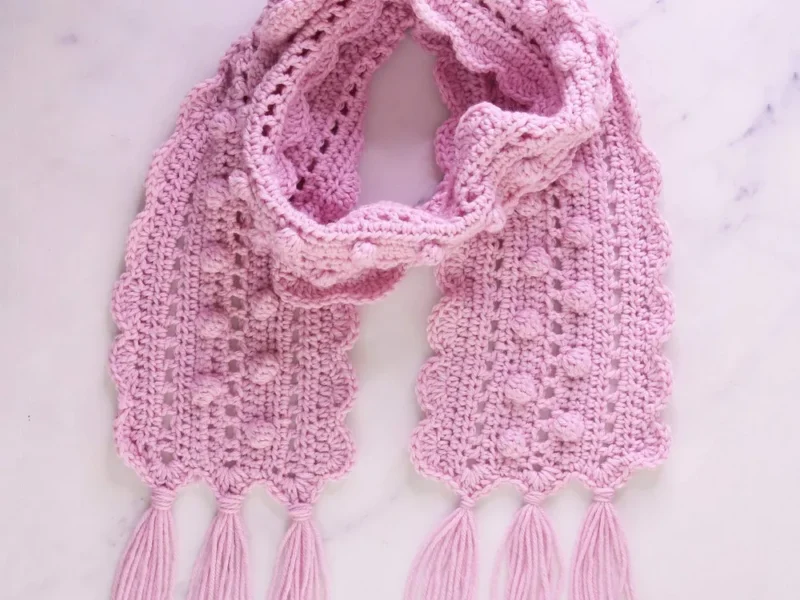
This one has the feel of a scarf that refuses to be boring. You start plain with rows of half double crochet, then the piece opens up into airy mesh, and later bobbles push up through the surface like little knots of texture. It never settles into one rhythm, and that keeps it interesting from the first chain to the last fringe.
Your hands get a real workout here, in the best way. You will move between hdc rows, mesh rows with their chain-one spaces, sc rows, and bobble rows, so you are constantly reading the stitch pattern instead of crocheting on autopilot. The border at the end asks you to join yarn precisely at the sixth stitch from the corner, which rewards a careful, attentive crocheter.
Finished and blocked, this scarf has real presence draped over a chair back or folded on a shelf. The mix of smooth hdc, open mesh, and raised bobbles catches light differently across its length, so it reads as handmade in the best sense. Fringe at the ends gives it movement the moment someone picks it up.
- Chain a long foundation row and work your first hdc row into the back bumps for a clean edge.
- Work a second hdc row straight across to build a solid, even base for the textured rows ahead.
- Continue through the full sequence, moving between hdc, mesh, sc, and bobble rows as the pattern directs.
- Watch the bobble rows closely since they are the rows that give the scarf its signature raised texture.
- Finish the body of the scarf and move on to the border for a clean, defined edge.
- Join new yarn at the specified corner stitch, keeping bobbles facing up as you work the border.
- Add fringe to the short ends once the border is complete for the finished look.
On the desk
Yarn
- Worsted Weight Yarn (10ply), 330m/360y
Crochet Hook
- 5mm or size to obtain gauge
Tapestry Needle
- For weaving in ends
Stitch shorthand
- sc — single crochet
- hdc — half double crochet
- dc — double crochet stitch
- ch — chain stitch
- sp — space
- sk — skip
- sl st — slip stitch
- st/sts — stitch/stitches
- Bobble Stitch — Special stitch creating the "bobbles" on the scarf
Textured fringe scarf with mesh and bobble rows
Main Pattern
- Round 1
(hdc row): Chain 201. Insert hook into the 3rd chain, hdc across the row into the back bumps. Turn.
- Round 2
(hdc row): Chain 2 (counts as first hdc), hdc across row. Turn.
- Round 3
Mesh row Chain 3 (counts as first dc), dc in next 2 stitches, chain 1, skip 1. *Dc, ch1, sk1. Repeat from * to last 3 stitches, dc in last 3 stitches. Turn.
- Rounds 4–15
Continue following the pattern's sequence, alternating between hdc rows, mesh rows, sc rows, and bobble rows, with specific instructions for each to create the textured pattern design.Border: Add a decorative border by joining yarn at the 6th stitch from the corner, ensuring bobbles face up, and follow the pattern to create a finished edge.
Fringe: Cut yarn into 12-inch pieces, fold in half, and attach to the scarf ends for a stylish fringe.Blocking: After completing your scarf, block it to enhance the appearance, even out stitches, and define edges.
Customizing: Feel free to adjust the length of your scarf or the size of the fringe for a personalized touch.
This pattern mixes skill-building techniques with creative expression, resulting in a stunning accessory that's both fun to make and fabulous to wear.
Where it goes
- Wrap it around your neck over a plain coat so the mesh and bobble texture becomes the outfit's main detail.
- Drape it over the back of a reading chair where the fringe can hang loose and catch attention.
- Fold it on a shelf or bench as a textured accent next to smoother, solid-color throws.
- Give it as a thoughtful handmade gift paired with a simple hat or mittens in a matching yarn.
Color ideas
- Soft pastel tones Work the whole scarf in a soft pastel shade of worsted weight yarn for a gentle, calm finish where the hdc, mesh, and bobble texture speaks quietly through the surface.
- Vibrant variegated yarn Choose a vibrant, variegated worsted weight yarn so the color shifts play up the changing hdc, mesh, sc, and bobble rows across the scarf's length.
Care
Hand wash the finished scarf in cool water with a mild detergent made for wool or acrylic blends, since worsted weight yarn can vary in fiber content.
Lay it flat on a towel to dry rather than hanging it, so the weight of the mesh and bobble sections does not stretch the fabric out of shape.
Store it folded rather than on a hook, and re-block gently with a light steam if the mesh or border edges lose their crispness over time.
Easy to get wrong
Losing the mesh row's rhythm
Count your chain-one spaces as you go instead of relying on sight alone, since a dropped chain-one throws off every repeat after it. Place a stitch marker every few repeats if you tend to lose count.
Bobbles facing the wrong way
Check which side of your work the bobbles are meant to sit on before you start the border, since the instructions specify bobbles facing up. Flip the scarf over and look at a bobble row before joining your border yarn.
Uneven hdc into back bumps
Take it slow on that very first row, since hdc into the back bumps of the chain is easy to rush and easy to split. Stretch the chain slightly as you go so each back bump stays visible and separate.
Between the songs
- What makes this one satisfying is the variety packed into a single long scarf. You get to practice four distinct stitch personalities: dense hdc for structure, open mesh with its chain-one gaps for drape, sc for a tighter transition, and bobbles for texture that pops off the surface. The mesh row alone, with its repeated dc-chain-skip sequence, trains your eye to read a pattern instead of just counting stitches. Then there is the border, worked precisely from the sixth stitch at the corner with bobbles facing up, which is a small technical flourish that makes the whole piece look finished rather than just stopped. It is the kind of project that keeps a long scarf from feeling like a slog.
Listener questions
Can I make the scarf shorter or longer than the pattern suggests?
Yes, the tips section specifically mentions adjusting the length to suit you. Just keep your row count consistent on both ends so the hdc, mesh, sc, and bobble sequence stays balanced.
Why does the first row ask me to work into the back bumps?
Working into the back bumps of the starting chain gives you a neater, more finished-looking edge on both sides of the scarf. It also makes the foundation row match the look of the other hdc rows more closely.
Do I need to block this scarf before adding the border?
It is best to complete the border and fringe first, then block the whole piece as the tips recommend. Blocking after the border helps even out the mesh openings and keeps the finished edge sharp.
What if my bobble rows are not sitting right?
Check that you are reading the bobble row instructions in order with the surrounding hdc and mesh rows, since skipping ahead can misalign the texture. Lay the piece flat and compare it to the row above before continuing.
Can I change the fringe length?
Yes, the tips note that fringe size is meant to be a personal choice. Cut a test strand first and fold it to check the look before cutting all your fringe pieces to match.
Original pattern: https://crocheteverything.com/crochet-penny-scarf-pattern/
About the Author

Marisol QuinteroWho runs Crochet Obsessed, why a stitch count sits at the end of every round, how a pattern gets written here, and the things this site will never do.
More Patterns
- IntermediateNo. 01

Rose Granny Square Tote Crochet Pattern
Rose granny square tote crochet pattern made from 18 dimensional rose squares for a sturdy, romantic everyday bag.
- IntermediateNo. 02
Tropical octopus baby blanket crochet pattern with appliqués
Tropical octopus baby blanket crochet pattern: a cream filet base with coral and turquoise octopus appliqués, leaves, and…
- IntermediateNo. 03
Sunny lemon couple amigurumi crochet pattern
Sunny lemon couple amigurumi crochet pattern with embroidered slices and safety eyes for a cheerful handmade shelf pair.