- LevelIntermediate
- Time16-22 hours
- Hook4.0 mm
- YarnWorsted
About This Pattern
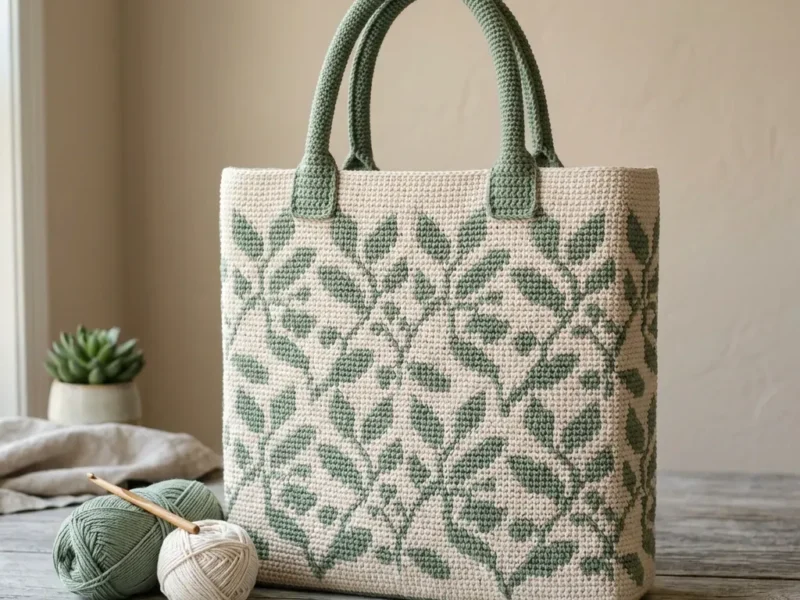
There is something quietly satisfying about a pattern that looks intricate from across the room and turns out to be built from one humble stitch. That is exactly the mood here. The sage leaves climb the cream background like something you would find pressed in an old book, calm and orderly.
Your hands spend most of this project doing the same small, steady job: single crochet, with a second color tucked underneath and picked up right on cue. There is no cutting yarn, no weaving in a dozen ends mid-round. Just a rhythm of watching the chart and trusting the stitch count to hold.
Once it is finished, this tote earns its place by the door or on a kitchen hook, structured enough to stand on its own. It reads as something you would pay good money for at a market stall. Set against plain walls or a wood table, the leaf trellis does all the talking.
- Start by building a firm rectangular base worked flat, back and forth, in plain single crochet rows.
- Pick up stitches around the entire outer edge of that base to transition into working in joined rounds.
- Join your contrast color and begin the leaf trellis, carrying the unused color invisibly inside each stitch.
- Repeat the charted leaf panel around the body, pausing occasionally to confirm the diamonds stack up straight.
- Work the final plain rounds in the main color only, then fasten off to finish the body.
- Crochet two flat strips for the handles, then fold each one lengthwise and whipstitch it into a firm cord.
- Attach the finished handles, then add any optional lining, base insert, or light blocking to sharpen the shape.
On the desk
- You’ll need worsted weight yarn (also called #4 or Aran weight) in 100% cotton. Cotton gives this bag its structure and durability, so I recommend sticking with it rather than substituting acrylic.
- Main Color (MC) in Cream: approximately 400 yards (366 meters)
- Contrast Color (CC) in Sage Green: approximately 320 yards (293 meters)
Suggested Yarn Brands
- Lily Sugar’n Cream in Soft Ecru and Sage
- Paintbox Yarns Cotton Aran in Vanilla Cream and Spearmint Green
- Hobbii Rainbow Cotton 8/8 in Off White and Dusty Green
- US G/6 (4.0 mm) for the body
- Tapestry needle
- Stitch markers
- Scissors
Optional
- lining fabric and firm base insert for extra structure
Stitch shorthand
- ch — chain
- sc — single crochet (insert hook, yarn over, pull up a loop, yarn over, pull through both loops)
- sl st — slip stitch
- st(s) — stitch(es)
- sk — skip
- rep — repeat
- yo — yarn over
- BLO — back loop only
- RS/WS — right side / wrong side
- MC — main color (cream)
- CC — contrast color (sage green)
Sage leaf trellis market tote crochet pattern
Making the Base
The base is a firm cream rectangle worked back and forth in rows. You’ll then pick up stitches all the way around its edge to begin working in the round.
- Round 1
With MC, ch 57. Sc in 2nd ch from hook and in each ch across; turn. (56 sc)
- Round 2
through 16: Ch 1, sc in each st across; turn. (56 sc)
Working the Body
Join CC and begin the leaf trellis, following either the chart or the written key above. Carry the resting color along inside every stitch.
- Round 1
through 24: Work the 24 stitch panel 6 times around, following the colorwork chart or key. Join each round to the first stitch. (144 sc)
- Round 25
through 48: Repeat chart Rounds 1 through 24 once more. (144 sc)
- Round 49
through 60: Repeat chart Rounds 1 through 12. Body measures approximately 11 inches (28 cm). (144 sc)
- Round 61
through 64: With MC only, sc in each st around; join. Fasten off. (144 sc) Helpful Tip: Pause at the end of each 24 round repeat to check that your diamonds line up vertically before continuing. This catches any mistakes early!
Handles (Make 2)
- Round 1
With CC, ch 9. Sc in 2nd ch from hook and each ch across; turn. (8 sc)
- Round 2
and onward: Ch 1, sc across until strap measures approximately 22 inches (56 cm). (8 sc)Fold each strap in half lengthwise with RS out and whipstitch the long edges together to form a firm round cord.
Where it goes
- A everyday market or grocery run, where the firm base and cotton fiber hold produce and jars without sagging.
- A structured project bag for carrying yarn, a current crochet-in-progress, or knitting notions to a group meetup.
- A beach or pool tote that pairs well with a plain terrycloth towel and a wide-brim sun hat.
- A everyday carryall for books or a laptop sleeve, especially once the optional fabric lining is added inside.
Color ideas
- Classic Sage and Cream Cream as the main color for the base, background rounds, and top plain rounds; sage green as the contrast color for the entire leaf trellis and both handles.
- Inverted Leaf Sage green as the main color for the base and the top plain rounds; cream as the contrast color worked into the leaf motif so the trellis reads pale against a deeper background.
Care
Hand wash the finished tote in cool water since it is worked entirely in 100% cotton, which holds up well to gentle washing but can lose shape if agitated too hard.
Lay it flat to dry rather than hanging it, so the wet cotton does not stretch under its own weight, especially through the handles.
Reshape it while damp into a crisp box form as noted in the pattern, then store it stuffed with tissue or a folded towel to keep the base square between uses.
Assembly
- Step 1 Optional Finishing Touches: Lining: Sew a fabric pouch approximately 12 × 24 inches with a 3.25 inch gusset and hand stitch it just below the rim. This protects the interior and adds polish. Structure: Slip a firm 10.5 × 3 inch panel into the base. Craft foam, plastic canvas, or cardboard covered in fabric all work well. Blocking: Mist lightly, shape into a crisp box, and let dry fully.
Easy to get wrong
Carried yarn peeking through stitches
Lay the resting color snugly along the top of the previous round before working over it, not loosely draped. A too-loose carry shows through as small dots on the right side.
Diamonds drifting off vertical
Stop at the end of each 24 round repeat and check the diamonds line up before moving on. Catching a one-stitch drift early saves ripping back through multiple rounds later.
Turning at the end of a round
Remember the body is worked with the right side always facing, so you never turn once you leave the base rows. Turning by habit will flip your chart and throw off the colorwork instantly.
Between the songs
- The real pleasure here is the tapestry technique itself: carrying the resting color invisibly along the top of each stitch so there is never a cut end to weave in. That single decision turns a fairly plain single crochet fabric into something with visual depth and a firm hand. Because the whole body works in joined rounds with the right side always facing you, the chart reads the same way every single round, so once the leaf repeat clicks, it clicks for good. Building from a solid single crochet base, through repeated chart rounds, into plain cream rounds and finally two folded straps gives the project a clear sense of progress. It is the kind of make where checking that your diamonds line up becomes its own small reward.
Listener questions
Can I substitute a different fiber for the cotton yarn?
I would not recommend it. Cotton is what gives this bag its structure and durability, and a springier fiber like acrylic will make the base and body feel floppy instead of firm.
Do I need to cut yarn between colors during the colorwork section?
No, and that is one of the best parts of this pattern. You carry the resting color invisibly inside your stitches and simply pick it up again when the chart calls for it.
Why does my colorwork panel look off after a few rounds?
This usually means the carried yarn is pulled too tight or too loose along the back of the stitches. Pause at the end of a chart repeat, check your diamonds against the chart, and adjust tension before continuing.
Is the base insert and lining required?
No, both are listed as optional finishing touches. They add polish and extra structure, but the bag holds its shape from the firm base rows and worsted cotton alone.
Why does gauge matter so much for this particular bag?
Because the finished dimensions and the way the base panel or lining fits depend on hitting the stated stitch and row gauge. I always work a swatch first and adjust my hook size if my stitches run tighter or looser than called for.
Original pattern: https://crochetwithmia.com/sage-green-botanical-leaf-tote-bag-free-crochet-pattern/
About the Author

Marisol QuinteroWho runs Crochet Obsessed, why a stitch count sits at the end of every round, how a pattern gets written here, and the things this site will never do.
More Patterns
- IntermediateNo. 01

Slouchy everyday beanie worked flat in half double crochet
Crochet beanie pattern for a slouchy everyday look worked flat with hdc rows, then seamed into a soft,…
- IntermediateNo. 02
Crochet amigurumi doll with dress, shoes, and hat
Crochet amigurumi doll pattern with dress, shoes, and hat details for a soft, huggable keepsake you build one…
- IntermediateNo. 03
Chunky moss stitch crochet sweater with raglan-free shoulders
Chunky crochet sweater pattern using moss stitch, worked flat with a 10mm hook for a soft, fast, cool-weather…