- LevelIntermediate
- Time4-6 hours
- Hook3.5 mm
- YarnDK
About This Pattern
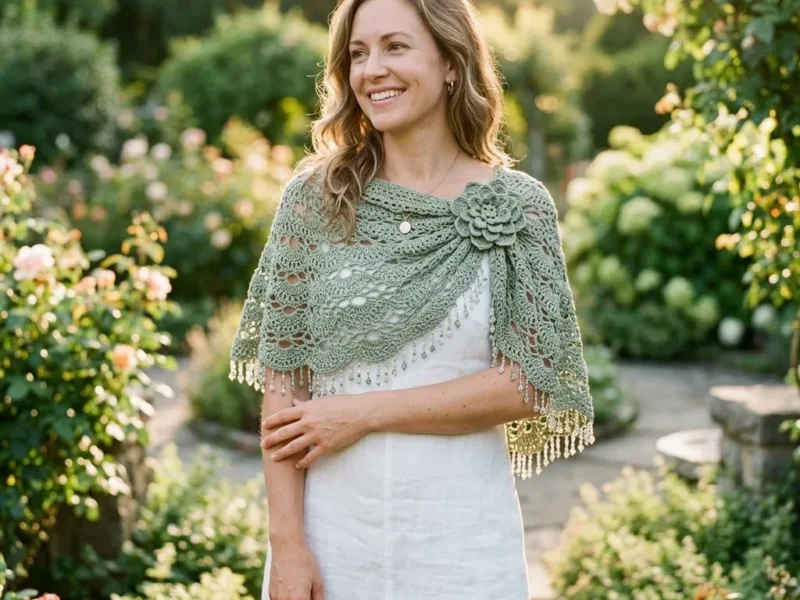
This one feels like a quiet morning in a garden before anyone else is awake. The sage green cotton has that cool, matte calm to it, nothing shiny or loud. It's the kind of piece you reach for when you want to look put together without trying hard.
Your hands will spend most of their time in double crochet, building the capelet shape row by row from the neck edge down. Then they slow down for the beaded fringe, threading teardrop beads onto folded yarn and knotting each one by hand. The rose brooch at the end asks for a tighter, more careful touch as the petals ruffle out.
Draped over a chair back or folded on a shelf, this wrap reads as texture first, color second. The rose brooch pinned to the front turns it into something that looks finished rather than just warm. It's a piece that looks like it took longer than it did.
- Work a gauge swatch first since drape depends on getting the stitch and row gauge right.
- Chain across the neck edge to start the main pattern, then turn and work back in rows.
- Build the capelet shape by increasing at set intervals on every row as you move downward.
- Keep stitch markers on your increase points so the spreading shape stays even on both sides.
- Set the main body aside and crochet the dimensional rose separately over its three rows.
- Fasten off the rose with a long tail, then coil and stitch it into a spiral bloom.
- Thread teardrop beads onto folded yarn and knot them along the lower edge for fringe.
- Wet block the finished wrap flat, then pin the rose brooch to a button or shank back.
On the desk
- Option 1 : Paintbox Yarns Simply DK (100% premium acrylic, 137 yards / 125 meters per 50 g skein). Use approximately 5 to 6 skeins in Spearmint Green or Pistachio. This yarn has excellent stitch definition and is machine washable, making it beginner friendly for a lace project.
- Option 2 : Lion Brand 24/7 Cotton DK (100% mercerized cotton, 186 yards / 170 meters per 100 g skein). Use approximately 4 skeins in Sage. The mercerized finish gives a slight sheen that beautifully mimics the finished look of this wrap.
- Option 3 : Paintbox Yarns Cotton DK (100% cotton, 137 yards / 125 meters per 50 g skein). Use approximately 5 to 6 skeins in Grass Green or Pistachio. Cotton will block beautifully and hold the lace open permanently.
Substitution Note
- Choose a smooth yarn with good stitch definition in DK weight. Avoid heavily textured, brushed, or variegated yarns as these will obscure the lace pattern. Look for a finished gauge of approximately 18 stitches and 10 rows to 4 inches in double crochet. Mercerized cotton or cotton blends are preferred for the drape and sheen visible in the finished piece.
Yarn
- Approximately 650 to 750 yards / 595 to 686 meters of DK weight (light 3) smooth mercerized cotton or cotton blend yarn in sage green.
Hook
- US size E-4 / 3.5 mm crochet hook for the wrap body and rose brooch.
Notions
- Stitch markers, at least 4
- Tapestry needle
- Approximately 150 to 180 small glass or crystal teardrop beads, approximately 6 to 8 mm in length, with a hole large enough to thread onto the yarn or a fine beading needle
- Fine beading needle and matching thread if bead holes are too small for direct yarn threading
- Blocking mats and rust proof pins
- Spray bottle or basin for wet blocking
- One button or shank pin back for the rose brooch, approximately 22 to 25 mm
Stitch shorthand
- beg — beginning
- bl — back loop only
- ch — chain (wrap yarn over hook and pull through the loop on your hook)
- ch-sp — chain space (the gap created by chain stitches in the previous row)
- dc — double crochet (yarn over, insert hook, pull up loop, yarn over and pull through 2 loops twice)
- dc2tog — double crochet two together (a decrease that combines 2 stitches into 1)
- dtr — double treble crochet
- fl — front loop only
- hdc — half double crochet (yarn over, insert hook, pull up loop, yarn over and pull through all 3 loops)
- lp(s) — loop(s)
- MC — main color (sage green)
- rem — remaining
- rep — repeat
- rnd — round
- RS — right side (the side that faces out when worn)
- sc — single crochet (insert hook, pull up loop, yarn over and pull through both loops)
- sk — skip
- sl st — slip stitch (insert hook, yarn over and pull through both loops at once)
- sp(s) — space(s)
- st(s) — stitch(es)
- t-ch — turning chain
- tr — treble crochet
- WS — wrong side (the side that faces your body when worn)
- yo — yarn over
Sage green garden wrap with dimensional rose brooch
Dimensional Rose
The rose is made from a long foundation strip that is then rolled and stitched into shape.
- Row 1
Chain 61; Sc in 2nd ch from hook and in each ch across. (60 sc)
- Row 2
Ch 3 (counts as dc), turn; Work 2 dc in same st; Work 3 dc in each st across. (180 dc)
- Row 3
Ch 1, turn; Sl st in each dc across; Fasten off, leaving a 24 inch tail for sewing.
Main Pattern
This crescent shaped wrap is worked from the top neck edge downward in increasing rows. The construction starts with a simple foundation and gradually introduces the lace pattern, so you have time to get comfortable with the rhythm before the fan stitches begin.
The body features a repeating fan and shell lace motif with open mesh sections that create an airy, breathable fabric. Along the lower edge, a scalloped picot border provides the perfect anchor point for crystal or glass bead fringe that catches the light beautifully.
Fan Stitch: Work 7 double crochet (dc) all into the same stitch or chain space. This creates the open fan shape visible along the lower body of the wrap. The stitches will naturally spread out to form a curved fan shape.
Shell Stitch (5-dc Shell): Work 5 dc all into the same stitch or chain space. Used in the upper body section where the pattern is a bit more compact.
Picot: Chain 3, then slip stitch into the first chain you made. This creates a small decorative loop used on the lower border.
Scallop Edging: Work (sc, hdc, 3 dc, hdc, sc) all into the same chain space. This combination creates the wave edging along the bottom from which your bead fringe will hang.
Where it goes
- Thrown over a sleeveless dress for dinner out, the rose brooch pinned where a collar would sit.
- Worn over a plain t-shirt and jeans to dress up a weekend errand without overdressing.
- Draped on the back of a reading chair as a textile accent that doubles as a throw.
- Packed in a bag as a cover-up for cool evenings after a day in the sun, paired with simple sandals.
Color ideas
- Monochrome sage Keep the main pattern and the dimensional rose in the same sage green cotton so the brooch reads as texture, not a color block.
- Soft contrast bloom Work the main pattern in sage green and crochet the dimensional rose in a second DK cotton shade, so the rose stands out against the capelet.
Care
Hand wash the wrap in cool water with a gentle detergent, since mercerized cotton holds its shape best without machine agitation.
Lay flat on blocking mats to dry, pinning the edges with rust proof pins so the capelet drape sets evenly.
Store folded flat rather than hung, and reshape by re-blocking if the cotton softens or curls after wear.
Assembly
- Step 1 Bead Fringe Unit: Cut a length of yarn approximately 8 inches / 20 cm; fold in half; using a crochet hook, pull the folded loop through a designated picot or chain space on the lower edge; pull the two cut ends through the folded loop and tighten to form a lark's head knot; thread one or two teardrop beads onto the two strands; tie an overhand knot below the bead(s) to secure; trim ends evenly to approximately 1 inch / 2.5 cm below the knot.
- Step 2 To assemble the rose: Starting at one end of the strip, roll the strip tightly to form the center of the rose; as you roll, allow the strip to curve naturally so the dc petal row fans outward; after every 5 to 6 stitches of rolling, use the yarn tail and tapestry needle to stitch through the base of the strip to hold the roll in place; continue rolling and stitching until the entire strip is formed into a rose shape; secure the end firmly; flatten the base slightly; attach a shank pin back or large button to the back of the rose for use as a brooch.
- Step 3 The separately crocheted dimensional rose brooch fastens the wrap at the front shoulder, allowing you to adjust the drape and fit to your preference.
Easy to get wrong
Skipping the gauge swatch
Block your swatch before measuring, since mercerized cotton relaxes and spreads once wet. Adjust your hook size up or down until the center stitches match gauge.
Losing track of increase rows
Place a stitch marker at each increase point as you work so the capelet spreads evenly on both sides. Recount at the end of every row before turning.
Between the songs
- The appeal here is in the contrast between two very different techniques living in one piece. The main body is a steady, meditative stretch of double crochet increases that spread the fabric into a capelet shape without any fuss. Then the beaded fringe interrupts that rhythm, each lark's head knot and teardrop bead a small deliberate pause. The dimensional rose is its own satisfying detour, just three rows worked at a tight gauge before it's coaxed into a spiral and tacked down. You get the hypnotic repetition crocheters love alongside finishing details that actually show off your hands. Nothing here outpaces your skill, but nothing feels like filler either.
Listener questions
Can I skip the beaded fringe and rose brooch?
Yes, the main pattern stands on its own as a plain capelet wrap. The fringe and brooch are finishing touches you can add later or leave off entirely.
What if my cotton yarn isn't mercerized?
A smooth cotton blend will still work, though the finished wrap may have a softer sheen and slightly different drape. Swatch and block first to see how it behaves before committing the full skein.
How do I know if my gauge is off?
Measure the center 18 stitches of your blocked swatch over 4 inches and compare to the stated gauge. If your swatch runs smaller, go up a hook size, and if it runs larger, go down one.
Can I adjust how many beads I use on the fringe?
Yes, the fringe count is flexible since each unit is made and attached individually along the lower edge. Use within the 150 to 180 bead range the materials list suggests, or fewer for a lighter look.
Do I need a beading needle for the teardrop beads?
Only if the bead holes are too small to thread the folded yarn directly. Keep a fine beading needle and matching thread on hand as a backup.
Original pattern: https://crochr.com/sage-green-garden-wrap-free-crochet-pattern/
About the Author

Marisol QuinteroWho runs Crochet Obsessed, why a stitch count sits at the end of every round, how a pattern gets written here, and the things this site will never do.
More Patterns
- IntermediateNo. 01

Blush pink bow front cardigan crochet pattern
Blush pink bow front crochet cardigan pattern builds a V-neck mesh cardigan with ribbed trim and soft tie…
- IntermediateNo. 02
Flamingo, pineapple and monstera leaf charm trio pattern
Flamingo pineapple monstera leaf charm trio: tiny thread crochet and amigurumi shaping turn small motifs into three charming…
- IntermediateNo. 03
Sage green daisy bow bucket bag crochet pattern
Sage green daisy bow bucket bag crochet pattern with a sculpted bucket base, gathered rim, and a petaled…