- LevelIntermediate
- Time4-6 hours
- Hook5 mm
- YarnWorsted
About This Pattern
There is something playful about this piece before you even pick up the hook. The stitch name promises feathers and fans, and the fabric actually delivers on that promise. I think of it as the stitch you reach for when single crochet alone feels a little too quiet.
Your hands will spend most of the time in a steady single crochet rhythm, then shift gears to skip stitches and build the fanned shaping that gives this its name. That shift keeps you paying attention round after round. It is not mindless, but it is not fussy either.
Once it is off the hook, this piece reads as structured and a little architectural, not fluffy or soft-edged the way a lot of worsted weight crochet can look. Drape it over the back of a chair or across a shelf edge and the texture catches the light differently from every angle. It holds its shape well enough to stay put wherever you set it.
- Start by working a foundation row of single crochet into the back bars of your chain for a clean base.
- Turn your work and chain one without counting it as a stitch before you begin the next row.
- Work a single crochet into the very first stitch to anchor the row before any skipping happens.
- Skip several stitches in sequence to open up the fanned shape that gives this stitch its texture.
- Repeat the single crochet and skip pattern across each row to build the peacock texture consistently.
- Keep turning and repeating the same rhythm across all four rounds of the main pattern.
- Check your tension every few rows so the fanned sections stay even from one side to the other.
- Finish off once you have worked through all the rounds and weave in your ends to tidy the edges.
On the desk
- Worsted weight acrylic yarn (or your choice of yarn)
- 5 mm crochet hook
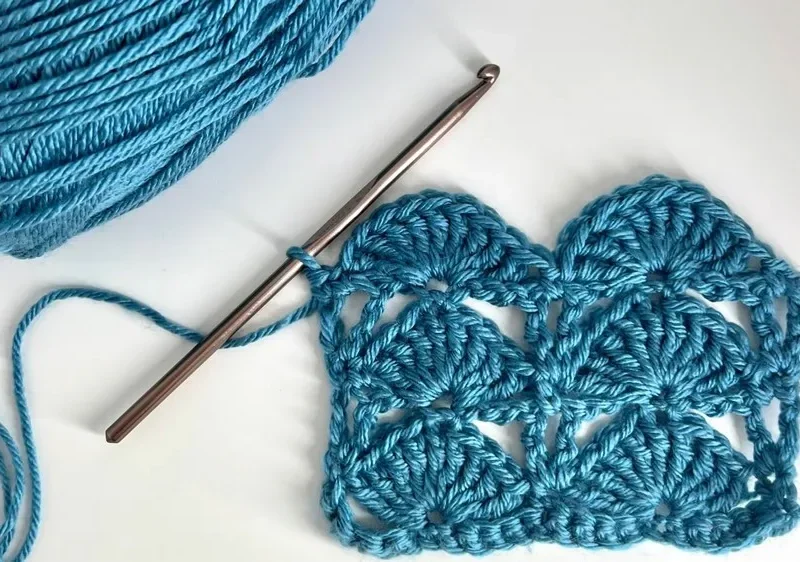
Peacock stitch crochet pattern for a textured scarf
Main Pattern
Foundation Chain Begin with a slip knot. Chain a multiple of 10, then add 2 additional chains. (For this example, 22 chains are made.)
- Round 1
Turn your work over and start in the back bars. Skip the very first chain. Single crochet in the second chain and in each chain across the foundation chain.This completes your foundation of single crochet stitches.
- Round 2
Chain 1 (this does not count as a stitch) and turn your work. Single crochet in the very first stitch. Skip 4 stitches. In the 5th stitch, work 9 treble crochets (this creates the "peacock" shell).Step by step: To work a treble crochet, yarn over twice; insert hook into the stitch and pull up a loop (four loops on your hook); yarn over and pull through two loops; yarn over and pull through two loops again; yarn over and pull through the final two loops.
Skip 4 stitches, work 1 single crochet in the next stitch. Repeat the pattern of skipping 4 stitches and creating a peacock shell in the 5th stitch across the row, ending with 1 single crochet in the final stitch. - Round 3
Chain 4 (counts as treble crochet) and turn your work. Work 1 treble crochet into the same stitch.Chain 3.
Single crochet into the 5th treble crochet of the previous row's peacock shell.Chain 3.Work 2 treble crochets into the single crochet from the previous row.Repeat the pattern of chain 3, single crochet into the 5th treble, chain 3, and work 2 treble crochets in single crochet across the row. - Round 4
Chain 1 (does not count as a stitch) and turn your work. Single crochet in the first stitch and in the space between the two treble crochets.In the single crochet from the previous row, work 9 treble crochets.
Repeat the pattern of a single crochet between the two treble crochets from the previous row and 9 treble crochets in the single crochet across the row.End with a single crochet in the top of the turning chain.Repeat rows 3 and 4 to continue the pattern for the desired length of your project.
More shots
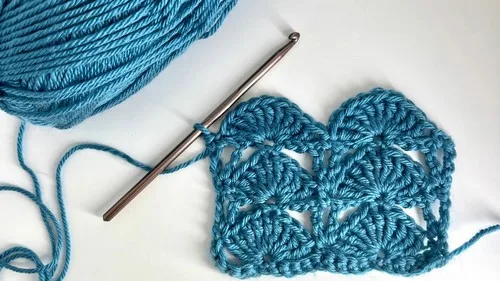
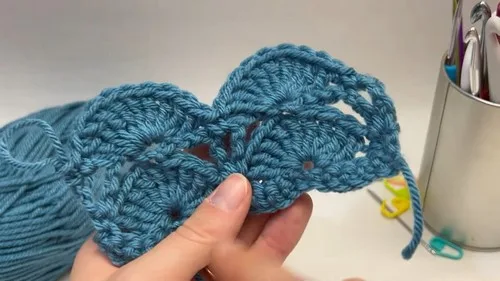
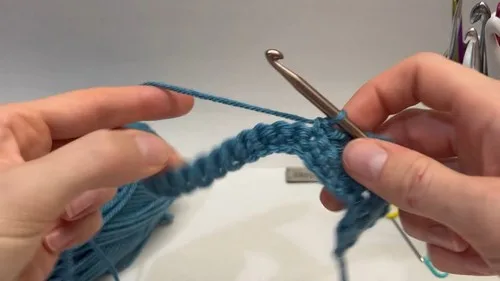
Where it goes
- A folded throw style piece across the arm of a sofa, paired with plain solid-color pillows so the texture stands out.
- A table runner down the center of a wooden dining table, set against simple ceramic dishware.
- A wall-hung textile piece stretched on a frame, hung near woven baskets or other fiber art for a cohesive corner.
- A scarf worn over a plain wool coat, where the fanned texture adds visual interest without competing with a busy print.
Color ideas
- Single tone, high texture Work all four rounds of the main pattern in one solid worsted weight color so the peacock fans read purely through texture and light, not color blocking.
Care
Hand wash in cool water with a gentle detergent, since worsted weight acrylic holds up well but still benefits from a light touch rather than a hot machine cycle.
Lay the piece flat on a towel to dry rather than hanging it, so the fanned texture does not stretch out of shape under its own weight.
Store it folded rather than on a hanger, and give it a quick reshape by smoothing the fanned rows flat before you tuck it away.
Easy to get wrong
Skipping the wrong stitch count
Count your skipped stitches carefully before working the next single crochet, since an off-by-one skip will shift the whole fan pattern out of alignment. Pause at the end of each repeat to recount before moving on.
Forgetting the chain one does not count
Remember that the turning chain at the start of row two is not a stitch, so do not work into it later. Treat it purely as a turn, then go straight into the first single crochet.
Working into the wrong loop on the foundation
Take a moment to find the back bars of your chain before starting row one, since working into the wrong part of the chain changes the texture of your base row. A clean foundation makes every later round easier to read.
Between the songs
- What makes this one satisfying is the contrast between the plain foundation and the patterned rows that follow. You start with a straightforward row of single crochet in the back bars of your chain, which gives you a clean, even base to build from. Then the skipped stitches start stacking into that fanned peacock texture, and you can watch the pattern emerge in real time rather than guessing how it will look when it is finished. There is a nice rhythm to turning your work, chaining one, and working into that first stitch before the skips begin again. It is repetitive enough to relax into, but the shaping keeps you from zoning out completely.
Listener questions
Why does my foundation row look different from the rest?
That is expected, since the foundation row is a plain line of single crochet worked into the back bars of the chain before the fanned pattern begins. The texture difference is intentional and gives the piece a clean starting edge.
Is this a good project for a confident beginner?
It helps to be comfortable with single crochet and counting stitches accurately before starting, since the skips rely on precise counting. If you have finished a few straightforward projects already, this is a reasonable next step.
What hook size does this pattern use?
This pattern is worked with a 5 mm crochet hook throughout all four rounds of the main pattern. Stick with that size unless you are intentionally adjusting for a different gauge.
How do I know if I am skipping the right number of stitches?
Lay your work flat after each repeat and check that the fanned sections look even and consistent with the ones before it. If something looks lopsided, it is worth unraveling back to the last clean repeat rather than pushing forward.
Original pattern: https://crocheteverything.com/how-to-crochet-peacock-stitch-tutorial-step-by-step/
About the Author

Marisol QuinteroWho runs Crochet Obsessed, why a stitch count sits at the end of every round, how a pattern gets written here, and the things this site will never do.
More Patterns
- IntermediateNo. 01

Rose Granny Square Tote Crochet Pattern
Rose granny square tote crochet pattern made from 18 dimensional rose squares for a sturdy, romantic everyday bag.
- IntermediateNo. 02
Tropical octopus baby blanket crochet pattern with appliqués
Tropical octopus baby blanket crochet pattern: a cream filet base with coral and turquoise octopus appliqués, leaves, and…
- IntermediateNo. 03
Sunny lemon couple amigurumi crochet pattern
Sunny lemon couple amigurumi crochet pattern with embroidered slices and safety eyes for a cheerful handmade shelf pair.