- LevelBeginner
- Time8-12 hours
- Hook4.0 mm
- YarnWorsted
About This Pattern
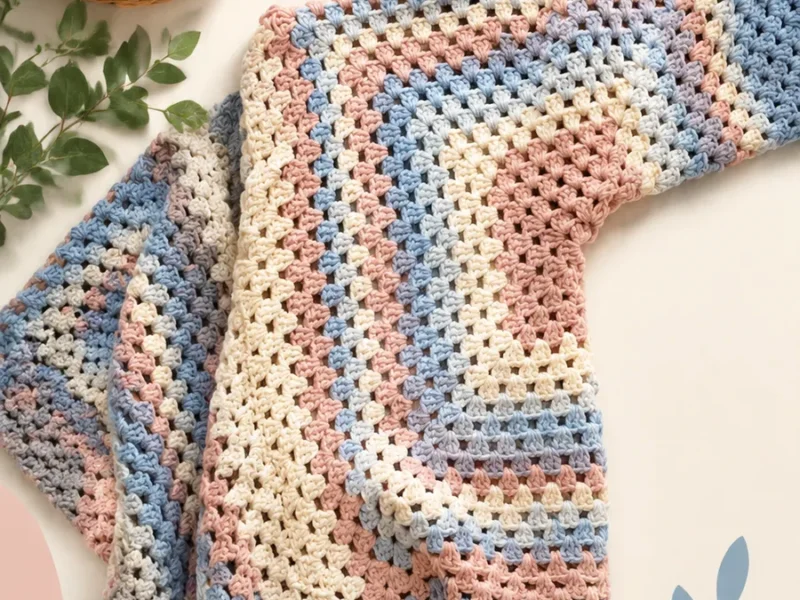
This one feels like a Sunday morning with the windows open. The pastel stripes in dusty blue, blush pink, cream, and neutral have that soft, unhurried quality, like a playlist you put on and forget to change. Nothing about it shouts, and that is exactly the appeal.
Your hands get a steady, repeatable job here: double crochet rows, turn, repeat, change color every four rows. There is no tricky shaping to second-guess, just the quiet rhythm of granny clusters building a textured surface. It is the kind of make you can pick up mid-conversation.
Once it is blocked and seamed, this cardigan drapes over a chair back or a hook by the door like it has always lived there. It reads as handmade without trying hard, the kind of piece a friend touches and asks where you got it. You get to say you made it.
- Start with the back panel, working double crochet rows straight across until it reaches its full length.
- Make two front panels the same way, shaping the neckline edge by leaving stitches unworked on one side.
- Change colors every few rows on each panel to build the horizontal stripe sequence.
- Work two sleeve rectangles separately using the same row-by-row double crochet method.
- Fold each sleeve lengthwise and seam the long edge using mattress stitch or a slip stitch seam.
- Join the back and front panels together to form the cardigan body.
- Attach the finished sleeves to the assembled body at the appropriate openings.
- Block the whole cardigan flat to even out the panels before wearing it.
On the desk
Color A
- soft blue
Color B
- blush pink
- Color C: cream
Color D
- light gray or neutral shade
- Approximately 1,800 yards (1,646 meters) total yarn
- 4.0 mm (US G/6) crochet hook
- Yarn needle
- Scissors
- Stitch markers
- Tape measure
Stitch shorthand
- ch — chain
- sl st — slip stitch
- sc — single crochet
- dc — double crochet
- sp — space
- st — stitch
- sk — skip
- rep — repeat
- RS — right side
- WS — wrong side
- UK equivalent note — US double crochet is the same as UK treble crochet.
Pastel sugarwheel cotton cardigan crochet pattern
Back Panel
With Color A, ch 85.
- Round 1
Dc in 4th ch from hook and in each ch across. Turn. (83 dc)
- Round 2
Ch 3, dc across. Turn. (83 dc)
- Round 3
Ch 3, dc across. Turn. (83 dc)
- Round 4
Ch 3, dc across. Turn. Change color after completing row.Rows 5-48: Repeat Rows 2-4, changing colors every 4 rows until the panel measures approximately 20 inches (51 cm) long.
Fasten off and weave in ends.
Front Panels (Make 2)
With Color A, ch 43.
- Round 1
Dc in 4th ch from hook and across. Turn. (41 dc)
- Round 2
48 Ch 3, dc across. Turn. Change colors every 4 rows. For the neckline edge, leave the final 8 stitches unworked on one side for shaping.Fasten off.
Sleeves (Make 2)
With Color A, ch 55.
- Round 1
Dc in 4th ch from hook and across. Turn. (53 dc)
- Round 2
34 Ch 3, dc across. Turn. Change colors every 4 rows. Fold sleeve rectangle lengthwise and seam the long edge using mattress stitch or slip stitch seam.Repeat for second sleeve.
Special Stitch
Granny Cluster: Work 3 dc into the indicated stitch or space.
Cluster Row Pattern: Ch 2, turn. Work 3 dc into each ch-1 space across, ending with 1 dc in the final stitch.
Where it goes
- Layer it open over a simple dress for an evening that turns cool once the sun drops.
- Keep it by the door as a grab-and-go topper over a plain tee and jeans.
- Give it as a handmade gift for someone who likes soft, wearable color over bold statements.
- Wear it over a tank top on an air-conditioned office day when you need gentle warmth.
Color ideas
- Dusty pastel original Soft blue and blush pink alternate through the back and front panel stripes, with cream and the light neutral breaking up the sequence every few rows, and all five pieces share the same color order for a matched look.
- Neutral-forward calm Lead with the light gray neutral and cream as the dominant stripes on the back and front panels, dropping in soft blue and blush pink as narrower accent rows, and keep the sleeves matching the body sequence so they blend in rather than stand out.
Care
Hand wash the cardigan or use a gentle machine cycle with mild detergent to keep the cotton fibers from stretching out.
Dry it flat on a towel rather than hanging, since wet cotton stretches under its own weight.
Block the panels gently into shape after washing and avoid pulling the fibers aggressively, since cotton relaxes naturally with wear.
Assembly
- Step 1 After assembly, gently block the cardigan by laying it flat and shaping the panels to the correct measurements. Avoid stretching cotton fibers aggressively because they naturally relax with use.
- Step 2 For care, hand washing or a gentle machine cycle with mild detergent is recommended. Allow the cardigan to dry flat to help maintain its shape.
Easy to get wrong
Losing count on stripe color changes
Use a stitch marker or sticky note to track which row you are on so the four-row color change stays consistent across all five pieces.
Uneven double crochet row edges
Count your stitches at the end of each row against the panel's starting count and keep your turning chain consistent so the sides stay straight for seaming.
Skipping the neckline shaping step
Pause before the final rows on each front panel and deliberately leave the stated stitches unworked on the neckline side, rather than working all the way across out of habit.
Between the songs
- What makes this one satisfying is the honesty of the construction: five flat panels, no mid-row shaping drama, just a back, two fronts, and two sleeves that you seam together at the end. The granny cluster texture does the visual heavy lifting, turning a simple double crochet fabric into something with depth and rhythm. Changing colors every four rows means you are rewarded often, watching the stripe sequence build without waiting through a long solid section. The neckline shaping on the front panels, leaving stitches unworked for that edge, is the one bit of technique that makes you feel like you have leveled up. Cotton gives you crisp stitch definition, so every cluster shows clearly instead of blurring into the surface.
Listener questions
Can I make this cardigan without changing colors every four rows?
Yes, you can work it in a single color if you prefer a solid look. The granny cluster texture will still show clearly in one shade of cotton.
Do I need to block the panels before seaming them together?
I recommend blocking each panel first so the edges lie flat and match up evenly. It makes seaming the back, front panels, and sleeves much more accurate.
Why does cotton yarn work especially well for this pattern?
Cotton gives the granny clusters crisp, visible definition and breathes well for layering. It also has enough structure to hold the panel shapes before and after blocking.
How are the sleeves attached to the body?
Each sleeve is folded lengthwise and seamed along the long edge first, using mattress stitch or a slip stitch seam. Then the finished sleeve is attached to the assembled body.
Is the neckline shaping difficult for a beginner?
It is a simple step, just leaving a set number of stitches unworked on one side of the front panel. It is the only shaping detail in the whole pattern.
Original pattern: https://duniarecipe.com/free-sugarwheel-cotton-crochet-patterns-easy-colorful-crochet-ideas/
About the Author

Marisol QuinteroWho runs Crochet Obsessed, why a stitch count sits at the end of every round, how a pattern gets written here, and the things this site will never do.
More Patterns
- IntermediateNo. 01

Rose Granny Square Tote Crochet Pattern
Rose granny square tote crochet pattern made from 18 dimensional rose squares for a sturdy, romantic everyday bag.
- IntermediateNo. 02
Tropical octopus baby blanket crochet pattern with appliqués
Tropical octopus baby blanket crochet pattern: a cream filet base with coral and turquoise octopus appliqués, leaves, and…
- IntermediateNo. 03
Sunny lemon couple amigurumi crochet pattern
Sunny lemon couple amigurumi crochet pattern with embroidered slices and safety eyes for a cheerful handmade shelf pair.