- LevelIntermediate
- Time2-4 Hours
- Hook3.5 mm
- YarnDK
About This Pattern
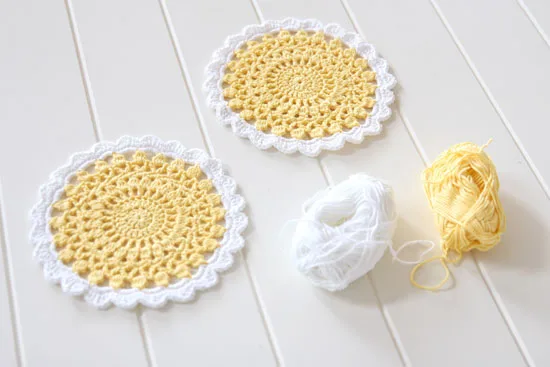
This pattern gives you a sunshine mandala worked in one continuous piece across nine rounds, each one radiating outward from the centre like light off a summer morning. What makes it special is how quickly the sun shape emerges: by the middle rounds you can already see the lacy rays forming, and the last two rounds bring the whole thing into focus with a wavy outer edge. It suits anyone who loves circular crochet, wants a small finishable make between bigger projects, or is ready to move past plain granny circles into something with real personality.
The work is all done in the round using trebles, doubles, half trebles and two decrease stitches (tr3tog and tr4tog) across the nine-round main pattern, with the increases spaced to keep the circle lying flat rather than cupping or ruffling. It is written at intermediate level, though the source is clear that beginners can absolutely learn these stitches as they go — nothing here is beyond a determined newcomer with a bit of patience. The instructions are written in UK terms, with the US shorthand for every round given directly beneath it, so work from whichever set you read fluently. Expect roughly two to four hours.
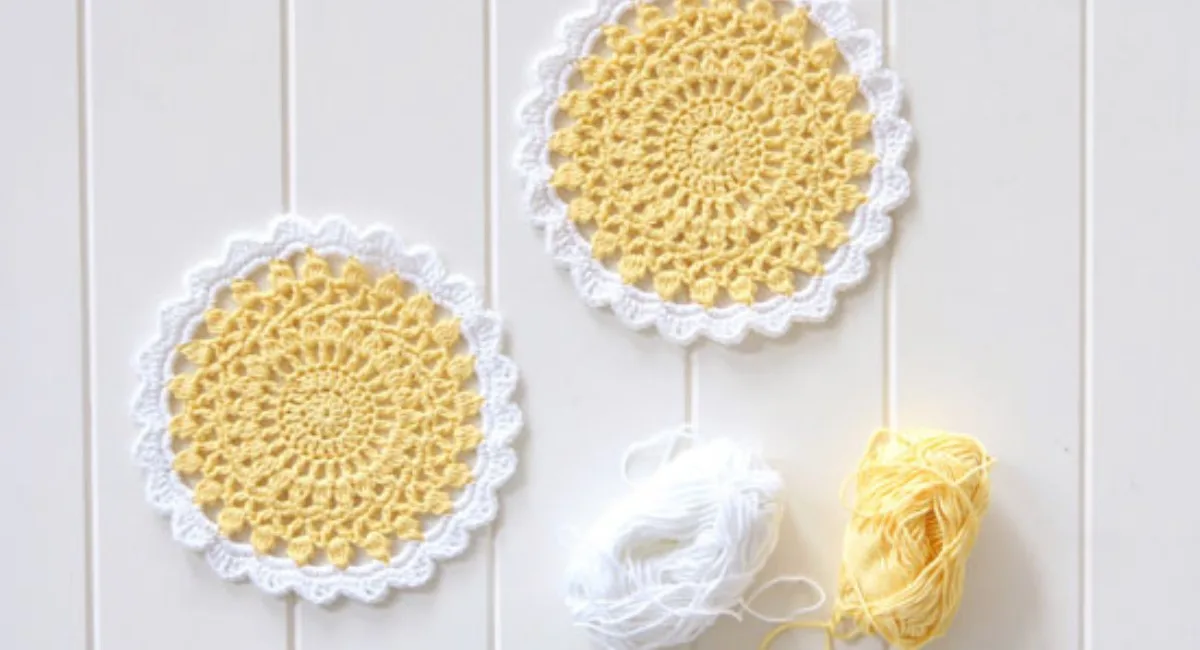
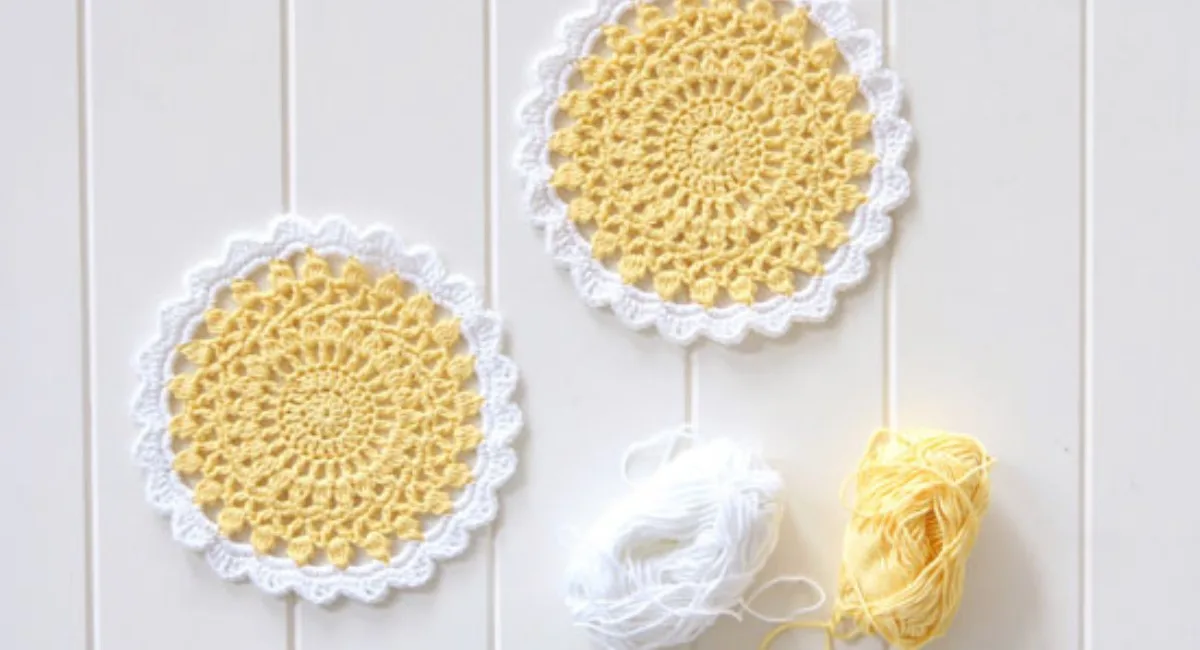
The finished mandala comes off the hook as a single flat circle with a sunny, radiating structure, worked in Patons Cotton Blend 8ply or another DK weight on a 3.5 mm hook. The sample uses a bright, happy yellow yoke for Rounds 1 to 7 and an egg-white surround for the final two rounds, though it looks pretty in other colour combinations too. That cotton-acrylic mix gives it crisp stitch definition with just enough softness to drape, so it sits nicely as a summer table mat or blocks flat for a wall hoop. Make one as a coaster-style accent, cluster three in different shades, or gift a set to someone who needs a bit of summer in their home.
- Choose your terminology first, since the main pattern is in UK terms with the US shorthand given beneath each round.
- Start the mandala at the centre with a magic ring in yellow and work 12tr into it, then double them to 24 in Round 2.
- Keep a stitch marker in the first stitch of each round so the joins stay lined up.
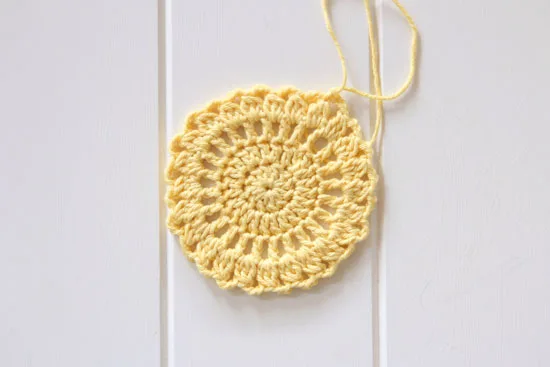
- Open the lace out with the tr, ch1 mesh of Round 3 and the tr3tog clusters of Round 4, watching the rays emerge as the circle widens.
- Count your stitches at the end of every round against the stated totals and fix any error before moving on.
- Cut the yellow at the end of Round 7 and join the white, then work 6dc into every ch-4 space in Round 8.
- Finish with the graduated dc, htr, tr edging of Round 9 to create the wavy border, then fasten off and weave the tails along the back of solid stitches so they stay hidden on both faces.
- Block the finished piece damp and pinned flat, then let it dry into a true circle.
Materials
- Patons Cotton Blend 8ply or DK weight: Cotton-acrylic blends mix up the characteristics of both these yarns. So, I found that best for my mandala.
- 3.5 mm Crochet Hook
- Two colours of that yarn: a happy, sunny yellow for the yoke (Rounds 1-7) and white or egg-white for the surround (Rounds 8-9)
- Yarn needle — Round 7 joins the last stitch with one before the colour change, and you will need it to weave in the ends
Crochet Abbreviations
- ch
- chain
- st
- stitch
- sl st
- slip stitch
- dc
- double crochet (UK) — called single crochet in the US
- htr
- half treble (UK) — called half double crochet in the US
- tr
- treble crochet (UK) — referred to as double crochet in the US
- tr3tog
- treble three together, a treble crochet decrease — dc3tog in US terms
- tr4tog
- treble four together, a treble crochet decrease — dc4tog in US terms
Free Crochet Sunshine Mandala Pattern for Summer
Main Pattern
Before you start Skill Level: Intermediate — beginners can also learn the stitches used here as they go. Pattern Note: the instructions are all written in UK terms; the US shorthand for each round is given directly beneath that round, so pick the system you read fluently and stay with it from Round 1 to Round 9.
Stitch guide The stitches you need for this crochet sunshine mandala pattern are as follows. ch = chain: yarn over and pull through the loop on the hook. dc = double crochet (called single crochet in the US): insert the hook into the stitch, yarn over the hook and pull up the loop (2 loops on hook), yarn over and pull through both two loops. htr = half treble (called half double crochet in the US): yarn over before inserting the hook into the stitch, yarn over the hook and pull up the loop (3 loops on hook), yarn over and pull through two loops, yarn over and again pull through two loops. tr = treble (referred to as double crochet in the US): yarn over twice before inserting the hook into the stitch, yarn over the hook and pull up the loop (4 loops on hook), yarn over and pull through two loops — repeat this two times more. sl st = slip stitch: for this joining stitch, yarn over and insert hook into the stitch, yarn over and pull up a loop, and go through both loops.
- Round 1
Start with a happy, sunny yellow colour. To begin, form a magic ring, chain 3 (this count as 1tr). Work 11tr into the loop, then slip stitch into the top of the ch3 at the beginning. Pull the magic circle to close. (12tr)US shorthand In US terms: 12dc into magic ring.
- Round 2
Ch3 (counts as 1 tr). 1tr into the same st. 2tr into each tr from the previous round. Slip st into the top of the beginning ch3. (24tr)US shorthand In US terms: 2dc in each dc from previous round. (24dc)
- Round 3(24)
Ch4 (counts as 1tr, 1ch). * 1tr into the next st, ch 1.* Repeat from * to * until end of round. Slip st into the third chain of beginning ch-4 (24tr, 24ch)US shorthand In US terms: 1dc, ch1 – around. (24dc, 24ch)
Special stitch Step by step — Treble Three Together (tr3tog), used in the next round: this is actually a treble crochet decrease, known as double crochet three together (dc3tog) in the US. Yarn over hook, insert into stitch, yarn over hook and pull up loop (3 loops on hook), yarn over and pull through two loops (2 loops on hook). Yarn over hook, insert into the next stitch instead, yarn over and pull up a loop (4 loops on hook), yarn over and pull through two loops (3 loops on hook). Yarn over hook, insert into next stitch, yarn over and pull up loop (5 loops on hook), yarn over, pull through 2 loops (4 loops on hook), yarn over and pull through all 4 loops.
- Round 4(24)
Slip st into ch-1 space, ch1 (this doesn’t count as a stitch). * tr3tog into ch-1 space, ch3 * Repeat from * to * until end of round. Slip st into the top of the first tr3tog. (24 tr3tog, 24 ch-3 spaces)US shorthand In US terms: dc3tog, ch3 into each ch1 space. (24 dc3tog, 24 groups of 3ch)
- Round 5(72)
Sl st into first ch-3 space, ch1 (doesn’t count as a stitch). Work 3dc into each ch-3 space from the previous round. Sl st into first dc. (72dc or 24 groups of 3dc).US shorthand In US terms: 3sc in each 3ch space. (24 groups of 3sc)
- Round 6(48)
Sl st into middle dc of 3dc group, that is, the 2nd dc. Ch5 (counts as 1tr, 2ch) and then 1tr into the same stitch. Find the middle of the next group of dc and work 1tr, ch2, 1tr into this stitch. Continue to work 1tr, ch2, 1tr into the second dc of of every 3dc group from the previous round. Sl st into the 3rd ch of the beginning ch5. (48tr, 48ch)US shorthand In US terms: into the middle stitch of each 3sc work 1dc, 2ch, 1dc. (48dc, 48ch)
Special stitch Step by step — Treble Four Together (tr4tog), used in the next round: this is a treble crochet decreasing technique, called dc4tog in the US. First, yarn over the hook, insert into stitch, yarn over hook and pull up loop (3 loops on hook), yarn over, pull through two loops (2 loops on hook). Yarn over hook, insert into next stitch, yarn over and pull up loop (4 loops on hook), yarn over and pull through two loops (3 loops on hook). Yarn over hook, insert into st, yarn over and pull up loop (5 loops on hook), yarn over pull through 2 loops (4 loops on hook). Yarn over hook, insert into st, yarn over and pull up loop (6 loops on hook), yarn over pull through 2 loops (5 loops on hook), yarn over and pull through all 5 loops.
- Round 7(24)
Sl st into ch-2 space, chain 1 (doesn’t count as a stitch) tr4tog, ch4. *tr4tog into the next ch-2 space, ch4 * repeat from * to * until end of round. As we are changing colours for the next round, cut your yarn and using a yarn needle, join your last stitch to the top of the first tr4tog and fasten off. (24 tr4tog, 24 ch-4 spaces).US shorthand In US terms: dc4tog, ch4 into each ch-2 space. (24 dc4tog, 24 groups of ch-4 spaces).
- Round 8(144)
Attach the white yarn to any ch-4 space with a sl st. Ch1 (doesn’t count as a stitch), then work 6dc into each ch-4 space. Sl st into the first dc. (144dc or 24 groups of 6dc)US shorthand In US terms: 6sc into every ch-4 space. (24 groups of 6sc)
- Round 9
Final round! ch1(doesn’t count as a st). Into each 6dc group work 1dc, 1htr, 1tr, ch1, 1tr, 1htr, 1dc. Sl st into first DC and fasten off. Wooohooo! You’re all done.US shorthand In US terms: into each 6sc group – 1sc, 1hdc, 1dc, 1ch, 1dc, 1hdc, 1sc. This graduated group of stitch heights is what gives the mandala its wavy outer edge.
More photos
Important Notes
- 💡 The pattern is written in UK terms throughout, with the US shorthand for each round given directly beneath it — decide which system you are reading before Round 1 rather than discovering the difference halfway through.
- 💡 Patons Cotton Blend 8ply was chosen deliberately: the cotton gives crisp stitch definition so the rays read clearly, and the acrylic keeps it from going stiff. Any DK weight cotton-acrylic blend will behave similarly, but pure cotton will be firmer and pure acrylic will be floppier.
- 💡 The 3.5 mm hook is on the smaller side for DK weight, which is intentional for a firm, defined fabric — but if you crochet tightly, go up to 4 mm so the centre does not cup. Test with the first two rounds before committing to the whole thing.
- 💡 Drop a stitch marker into the first stitch of each of the nine rounds and move it up as you go. Mandala mistakes are almost always at the join, and a marker turns a full recount into a five-second check.
- 💡 Blocking is not optional for a flat circular piece. Pin the finished mandala out damp on a towel or foam mat, easing the outer edge into a true circle, and let it dry fully — the difference between a blocked and unblocked mandala is dramatic.
- 💡 If you want to work more than one, make them all in a single sitting with the same hook and the same yarn ball. Tension shifts subtly between sessions, and a set of matching mandalas is only convincing if they are genuinely the same size.
- 💡 Colour plan: the sample is a bright, happy yellow yoke worked from Round 1 through Round 7, then egg-white for Rounds 8 and 9 — the colour change happens at the end of Round 7, where you cut the yellow and fasten off before attaching the white. It looks lovely in other colour combinations too, so this is the place to make it yours.
Common Mistakes and Fixes
- Losing the start of the round
Mandalas worked in the round are unforgiving about this because the increases need to stack in a predictable relationship to each other for the rays to stay symmetrical. Place a stitch marker in the first stitch of every single round and move it up as you begin the next one. If you find Round 6 has one stitch too many, count back from your marker rather than guessing — it is almost always a doubled stitch right at the join.
- Working too tightly on the 3.5 mm hook
A 3.5 mm hook with DK weight is deliberately snug, which gives crisp stitch definition, but if you are a tight crocheter the early rounds will pull into a bowl instead of staying flat. Consciously loosen your yarn tension for the first three rounds, or go up half a hook size to 4 mm if your gauge naturally runs tight. A gently blocked mandala should sit flat on the table without a hand on it.
- Miscounting stitches in the increase
The opposite problem to cupping: too many stitches in a round makes the outer edge wave and frill instead of lying flat. Count your stitches at the end of every round against the number the pattern states — 12tr, 24tr, 24 tr3tog, 72dc and so on — without exception, and do not carry an error forward hoping it will even out. Frogging back one round is annoying; frogging back four because you ignored a wrong count at Round 3 is much worse.
- Skipping or misplacing the turning
The starting chain stands in for a stitch of a particular height, and whether it counts as a stitch or not changes your total for the round. This pattern tells you each time — the ch3 in Round 1 counts as 1tr, the ch4 in Round 3 counts as 1tr and 1ch, while the ch1 in Rounds 5, 7, 8 and 9 does not count as a stitch. Read the round instruction carefully and apply that treatment consistently, or you will get a visible seam line running from the centre out to the edge.
- Weaving in ends carelessly on a flat, double-sided piece
Unlike a stuffed toy, both faces of this mandala are on display, and the colour change at Round 7 leaves you extra tails to deal with. Weave each tail along the back of a solid stitch column rather than through an open space where it will show through, split the yarn plies as you go for grip, and change direction once before trimming. Do this after blocking, not before, so the ends are not pulled tight by the stretch.
Variations
- The obvious first swap is colour, and this shape rewards it. Classic sunshine is a golden yellow centre with an egg-white surround, but try a sunset version instead: deep coral in the middle moving out through tangerine to a soft peach on the last round. A moonlight variation in silver grey, cream, and pale blue turns the same nine rounds into something completely different for a cooler room. If you want the rays to really pop, work the centre rounds in your sun colour and the outermost rounds in a contrasting sky blue so the shape gets outlined. Size is easy to play with because it comes down to yarn and hook. Move up to a worsted or aran weight with a 5 mm hook and the same nine rounds give you a noticeably bigger mandala with a chunkier, more rustic look — good for a wall piece. Drop to a 4 ply cotton with a 2.5 mm or 3 mm hook and you get a delicate, doily-scale version that suits a small side table. Do not change stitch counts to resize; changing yarn weight keeps all the increases and the flat lie intact, which is much safer than improvising extra rounds. For yarn substitutions, Scheepjes Stone Washed, Drops Paris in a lighter hook, or Lily Sugar'n Cream all work if you like a firmer cotton hand. Stylecraft Special DK is the budget-friendly acrylic option if you want maximum colour choice. For themed sets, a bundle in warm autumn ochres, dusty rose, and rust makes the same sun read as a harvest motif — same nine rounds, entirely new mood.
- I have made a lot of circles in my time, and this one keeps pulling me back because the sun actually looks like a sun. There is a real moment around the middle rounds where the rays stop being abstract stitches and suddenly read as light spreading outward — I always stop and hold it up to the window when that happens. Nine rounds is exactly the right length, too. It is long enough to feel like a proper project with shape and progression, but short enough that I can start it after dinner and have a finished mandala before I go to bed. The Patons Cotton Blend 8ply was a genuinely good call: cotton alone can be stiff and squeaky on a 3.5 mm hook, and pure acrylic goes soft and shapeless in a flat circle, but the blend sits right in between. My stitches stay sharp and defined where the rays need definition, and the whole thing still relaxes into a nice flat lie when I block it. It is a small, satisfying, sunny thing to make.
Frequently Asked Questions
Do I have to be an intermediate crocheter to make this?
The pattern is rated intermediate, but the source notes that beginners can learn the stitches used here as they go. If you are comfortable working in the round and can count your stitches reliably, you have everything you need to get through all nine rounds — the stitch guide and the tr3tog and tr4tog walkthroughs are written out in full with the pattern.
The instructions look different from what I am used to — why?
The main pattern is written in UK crochet terminology, where stitch names differ from the US system you may know: a UK treble is a US double crochet, and a UK double crochet is a US single crochet. The US shorthand for every round is included right beneath that round, so pick the set that matches how you read and follow it consistently from the first round to the last.
Can I use a different yarn than Patons Cotton Blend 8ply?
Yes, any DK or 8ply weight yarn will work with the 3.5 mm hook. The cotton-acrylic blend was chosen because it combines cotton's stitch definition with acrylic's softness, so a similar blend will give you the closest result to the original.
My mandala is curling up at the centre instead of lying flat. What went wrong?
That is almost always tension — a 3.5 mm hook is snug for DK weight, and tight stitches in the early rounds pull the circle into a bowl. Loosen your tension or move up to a 4 mm hook, and block the finished piece damp to help it relax into a flat circle.
When do I change colour?
the very end of Round 7. The instruction tells you to cut your yellow yarn, use a yarn needle to join your last stitch to the top of the first tr4tog, and fasten off — then Round 8 attaches the white yarn to any ch-4 space with a slip stitch. Rounds 8 and 9 are both worked in the second colour.
Original pattern: https://redagapeblog.com/crochet-sunnyside-up-mandala-pattern/
About the Author

Marisol QuinteroWho runs Crochet Obsessed, why a stitch count sits at the end of every round, how a pattern gets written here, and the things this site will never do.
More Patterns
- IntermediateNo. 01

Slouchy everyday beanie worked flat in half double crochet
Crochet beanie pattern for a slouchy everyday look worked flat with hdc rows, then seamed into a soft,…
- IntermediateNo. 02
Crochet amigurumi doll with dress, shoes, and hat
Crochet amigurumi doll pattern with dress, shoes, and hat details for a soft, huggable keepsake you build one…
- IntermediateNo. 03
Chunky moss stitch crochet sweater with raglan-free shoulders
Chunky crochet sweater pattern using moss stitch, worked flat with a 10mm hook for a soft, fast, cool-weather…