- LevelIntermediate
- Time4-6 Hours
- Hook4 mm
- YarnDK / 8ply
About This Pattern
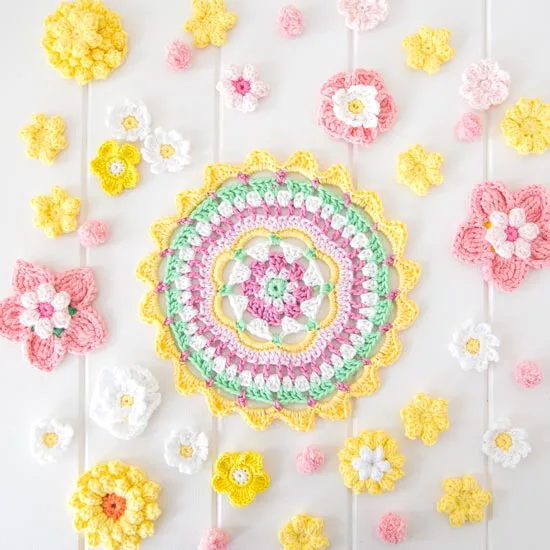
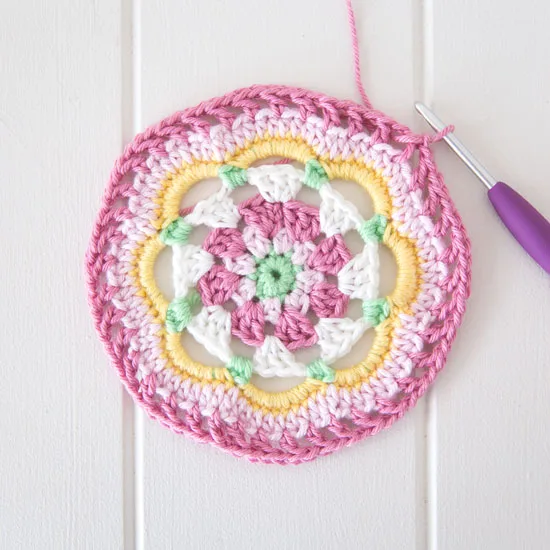
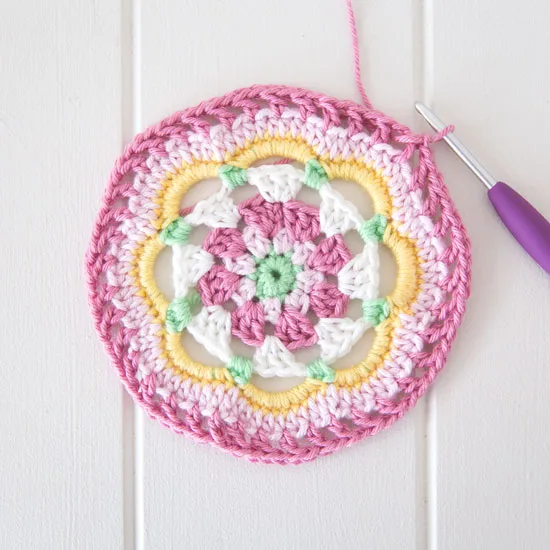
This free crochet mandala by Mandy grows from a tiny center ring into a full circle of granny clusters worked in five cotton shades — Neo Mint, Pink, Wild Rose, White and Yellow. What makes it special is the way familiar granny-square logic gets bent into the round, so the same three-double-crochet groups you have made a hundred times suddenly read as petals and rings instead of corners. It is perfect for crocheters who love color play, want a decorative finish fast, and enjoy watching a piece bloom outward round by round.
Technique-wise you will lean on granny clusters, chain spaces, slip-stitch joins and clean color changes at the start of a new round, plus the second granny section that gives the middle of the mandala its structure. None of it is difficult on its own, but keeping your clusters landing in the right chain spaces takes attention, which puts this squarely at a confident-beginner to intermediate level. Most makers finish in four to six hours, and because it is worked in the round with no assembly steps, you can stop and restart between color changes without losing your place.
The finished mandala comes off the hook as a flat, springy circle roughly the size of a small plate, though your exact measurement depends on tension and how many cluster rounds you decide to add. Worked in 8ply cotton blend on a 4mm hook, it has real body — it holds its shape on a table instead of flopping, and the cotton gives the colors a clean, matte brightness. Block it, and it becomes a centerpiece mat, a wall hanging, or a gift that looks far more involved than the few hours it actually took.
- Start with a small center ring in your first color and pull it snug before working the opening round.
- Build your first granny clusters into that ring, spacing the groups evenly so the center lies perfectly flat.
- Join with a slip stitch, fasten off, and bring in the next shade at a chain space to begin the following round.
- Work the second granny section as written, keeping every cluster in its chain space rather than on top of a stitch.
- Continue outward round by round, swapping to a new color each time the pattern calls for the next shade.
- Check your cluster count at the end of each round so the circle stays flat instead of cupping or rippling.
- Fasten off after the final round, then weave every tail into the backs of matching stitches and trim closely.
- Wet or steam block the mandala, pinning the outer edge into a smooth circle until it dries completely.
Materials
- Paton’s Cotton Blend 8ply: Yarn A – Neo Mint, Yarn B – Pink, Yarn C – Wild Rose, Yarn D – White, Yarn E – Yellow Or any 8ply/dk yarn
- 4mm crochet hook
- A smaller hook size is better for attaining the details.
- Scissors
- Yarn needle
Crochet Abbreviations
- Rnd 1
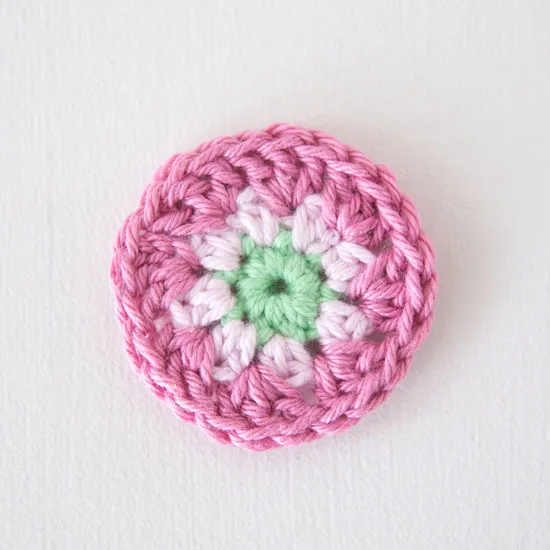
- {Starting with Yarn A} work 8 sc in a magic ring. Fasten off. [8 sc]
- Rnd 2
- {Attach Yarn B with a sl st into any sc} ch 2 (counts as one hdc), hdc in same st, 2 hdc in each sc around. Fasten off. [16 hdc]
- Rnd 3
- {Attach Yarn C with a sl st in between any of the 2 hdc pairs } ch 3 (counts as dc), 2 dc in same st, 3 dc in between each of the hdc pairs. Fasten off. [24 dc]
- Rnd 4
- {Attach Yarn D with a sl st in between any of the 3 dc groups} ch 3 (counts as dc), 2 dc in same sp, 2 ch, *3 dc in between next 3 dc group, 2 ch * repeat from * around. Fasten off. [24 dc, 16 ch]
- Rnd 5
- {Attach Yarn A with a sl st into any 2 ch-sp} * (2 sc in 2 ch-sp + ch 5),repeat from * around. Fasten off. [8 sc, 8 groups of 6 ch]
- Rnd 6
- {Attach Yarn E with a sl st in any 5 ch-sp} work 10 sc over each 5 ch-sp around. Fasten off. [80 sc]
Free Crochet Mandala Pattern for Colorful Decor and Gifts
Forth Round (Second Granny!)
- Round 4
{Attach Yarn D with a sl st in between any of the 3 tr groups} ch 3 (counts as tr), 2 tr in same sp, 2 ch, *3 tr in between next 3 tr group, 2 ch * repeat from * around. Fasten off. [24 tr, 16 ch]
- Round 5
{Attach Yarn A with a sl st into any 2 ch-sp} * (2 dc in 2 ch-sp + ch 5),repeat from * around. Fasten off. [8 dc, 8 groups of 6 ch]
- Round 6(80)
{Attach Yarn E with a sl st in any 5 ch-sp} work 10 dc over each 5 ch-sp around. Fasten off. [80 dc]
Rnd 7
{Attach Yarn B with a slip stitch into any dc } ch 2 (counts as htr), htr into each dc around. Fasten off. [80 htr]
- Round 8
{Attach Yarn C with a sl st into any htr} 4 ch (counts as tr + ch), *miss one htr, (tr + ch) in the next st, rep from * around. Fasten off. [40 tr, 40 ch]
- Round 9(100)
{Attach Yarn D with a sl st into any ch-sp } ch 2 (counts as htr), 2 htr in the same sp, 2 htr in the next ch-sp , *3 htr in the next ch-sp, 2 htr in the next ch-sp, rep from * around. Fasten off. [100 htr]
- Round 10
{Attach Yarn A with a sl st in between any of the htr clusters } ch 3 (counts as tr), tr in the same sp, 2 tr + ch in between the next cluster, *(2 tr in between the next cluster, 2 tr + ch in between the next cluster), rep from * around. Fasten off. [80 tr, 40 ch]
- Round 11
{Attach Yarn C with a sl st in 1 ch sp} dc in same sp *ch 5, skip 4 tr and then dc in the next ch-sp, rep from *around. Fasten off. [100 ch, 20 dc]
- Round 12(20)
{Attach Yarn E with a sl st into any 5 ch-sp,} work (2 dc + htr + tr + dtr + tr + htr +2 dc) in each 5 ch-sp, around.Fasten off. [20 petals]
Rnd 7
{Attach Yarn B with a slip stitch into any sc } ch 2 (counts as hdc), hdc into each sc around. Fasten off. [80 hdc]
- Round 8
{Attach Yarn C with a sl st into any hdc} 4 ch (counts as dc + ch), *miss one hdc, (dc + ch) in the next st, rep from * around. Fasten off. [40 dc, 40 ch]
- Round 9(100)
{Attach Yarn D with a sl st into any ch-sp } ch 2 (counts as hdc), 2 hdc in the same sp, 2 hdc in the next ch-sp , *3 hdc in the next ch-sp, 2 hdc in the next ch-sp, rep from * around. Fasten off. [100 hdc]
- Round 10
{Attach Yarn A with a sl st in between any of the hdc clusters } ch 3 (counts as dc), dc in the same sp, 2 dc + ch in between the next cluster, *(2 dc in between the next cluster, 2 dc + ch in between the next cluster), rep from * around. Fasten off. [80 dc, 40 ch]
- Round 11
{Attach Yarn C with a sl st in 1 ch sp} sc in same sp *ch 5, skip 4 dc and then sc in the next ch-sp, rep from *around. Fasten off. [100 ch, 20 sc]
- Round 12(20)
{Attach Yarn E with a sl st into any 5 ch-sp} W ork (2 sc + hdc + dc + tr + dc + hdc +2 sc) in each 5 ch-sp, around.Fasten off. [20 petals]
More photos
Important Notes
- 💡 Stick with the 4mm hook — the source notes that a smaller hook gives better detail, and in 8ply cotton blend that is exactly right. The clusters stay crisp, the chain spaces stay open and tidy, and the finished mandala holds its shape on a table instead of collapsing.
- 💡 Use stitch markers generously, as Mandy recommends. Drop one in the first cluster of every round and a second one at your color-change point. Even experienced crocheters lose track of which round they are on when the pattern moves from the granny sections into the outer rounds, and one marker saves an hour of frogging.
- 💡 Any 8ply or DK yarn works, but keep all five colors in the same weight and preferably the same brand. Mixing a slightly thicker shade into one round will pull that round tighter than its neighbors and warp the circle in a way blocking cannot fully fix.
- 💡 Wind your five colors into small separate balls or keep them in individual bags before you start. Cotton loves to tangle, and with this many shade changes, five minutes of setup saves you from a knotted pile halfway through the mandala.
- 💡 Count your clusters at the end of every single round, before joining. It takes fifteen seconds and it is the only reliable way to catch a missed chain space early — on a circular piece, one error compounds outward and shows up as a wobble three rounds later.
- 💡 Block the finished mandala. Wet or steam block it, pin the outer edge into a smooth circle on a towel or blocking mat, and let it dry completely. Cotton takes blocking beautifully, and this one step turns a slightly wavy make into a piece that looks professionally finished.
Common Mistakes and Fixes
- Leaving the starting center ring loose, so the mandala has a hole in the middle instead of a solid core.
After you finish the first round of clusters into the ring, pull the starting tail firmly to cinch the center closed before you join and move on. Do this while the round is still fresh — once you have three or four rounds on top, the tail no longer travels freely and the hole is permanent. Give the tail a second gentle tug after the following round, then weave it in securely so it cannot work loose later.
- Working granny clusters into the top of stitches instead of into the chain spaces between them.
Every cluster in a granny-based mandala belongs in the gap created on the previous round, not into the V of a double crochet. Before starting each group, stop and look for the actual open space under your hook. If your circle is turning bumpy, dense or refusing to lie flat, that is almost always the culprit — pull back to the last correct round and rework it, placing each cluster in its chain space.
- Joining a new color mid-stitch or in a random spot, which leaves a visible jog and a weak point in the round.
Make every color change at the same place each round — complete the final slip-stitch join of the old color, fasten off, then start the new shade in a chain space rather than on top of a stitch. Keeping all your joins stacked in one line means the seam disappears into the pattern, and you can hide it at the back when you hang or display the mandala.
- The mandala cups upward like a bowl, or ruffles at the edges instead of sitting flat.
Cupping means you are not adding enough stitches as the circle widens; ruffling means you are adding too many. Count the clusters in the round you just finished against the round below and check you have not skipped or doubled a chain space. If your counts are right and it still cups, your tension is tightening as you tire — try going up half a hook size for the outer rounds only, then block the finished piece flat.
- Using a hook larger than the recommended 4mm because it feels faster.
Mandy specifically recommends staying at 4mm or smaller in 8ply cotton, and it matters here — the whole charm of this mandala is tight, defined clusters with neat little windows between them. A 5mm or 5.5mm hook makes the fabric floppy, blurs the granny detail, and leaves gaps that look like mistakes. If your stitches feel cramped, loosen your yarn hand rather than sizing up the hook.
- Cutting yarn tails short and knotting them, then finding lumps and loose ends after blocking.
five colors you will have ten or more tails, so leave at least six inches every time you fasten off and weave each one with the yarn needle through the backs of stitches in its own color. Travel in two directions before trimming so the end locks itself in. Knots create visible bumps on a flat piece and will eventually pop through to the front.
Variations
- The five-color sequence is the easiest thing to play with here. Swap Mandy's Neo Mint, Pink, Wild Rose, White and Yellow for a moody palette — charcoal center, dusty teal, rust, oatmeal and cream — and the same mandala reads as modern rather than sweet. A tonal version is gorgeous too: pick one hue and run it from palest to deepest as you move outward, so the circle looks like it is glowing from the middle. If you want maximum contrast, keep White as every second color so each bright shade sits between crisp outlines. For size, just keep going: repeat the outermost cluster round, adding one extra three-double-crochet group in each corner or spacing chain each time around, and stop the moment the edge starts to ripple. Two or three extra rounds turns the mandala into a table centerpiece; six or seven and you are heading toward a small round mat. Going smaller works as well — fasten off right after the granny sections and you have a coaster set in five colorways from a single yarn pack. Yarn substitutions are easy since any 8ply or DK will do: Paintbox Yarns Cotton DK gives the same crisp stitch definition with more shade choices, Scheepjes Catona (held as DK weight or on a smaller hook) makes a finer, more delicate version, and a DK cotton-acrylic blend like Stylecraft Classique will soften the drape if you want a wall hanging rather than a stiff mat. Seasonal versions are lovely — soft greens and creams for spring, deep golds and berry tones for autumn.
- I have made a lot of mandalas, but this one won me over the moment the second granny section started to take shape. There is something deeply satisfying about watching plain three-double-crochet clusters stop behaving like a square and start curving into a ring — the same stitch you know by heart suddenly looks like something else entirely. The five-color run from Neo Mint through Pink, Wild Rose, White and Yellow does a lot of the work for you: every time you join a new shade the piece looks finished all over again, which is dangerously motivating when you meant to stop for the night. I also love that the 4mm hook keeps everything tight and defined, so the chain spaces read as tiny windows rather than sloppy gaps. And because it is worked entirely in the round with no assembly, there is no seaming, no stuffing and no fiddly joining — you simply fasten off, weave in your tails, block it flat, and admire something that looks far more complicated than it actually was.
Frequently Asked Questions
Do I have to use all five colors, or can I make this mandala in one shade?
You can absolutely work it in a single color, and a one-shade mandala in cream or charcoal looks wonderfully sculptural. Just be aware that the color changes are what make the round structure easy to read, so mark the start of each round with a stitch marker if you go monochrome.
What size does the finished mandala end up?
Worked as written in 8ply cotton blend on a 4mm hook, it finishes as a flat circle roughly the size of a small plate, though your tension will shift that slightly. You can make it larger by repeating the outer cluster round or smaller by fastening off earlier.
Can I substitute acrylic yarn instead of the Paton's cotton blend?
Yes, any 8ply or DK acrylic will work fine for the stitches themselves. The main difference is drape — cotton gives you a firm, structured mandala that sits flat on a table, while acrylic is softer and floppier, which is better if you want to hang it than if you want a mat.
My mandala is curling up at the edges. What went wrong?
Curling or cupping usually means the outer rounds do not have enough stitches to keep up with the growing circumference, often from skipping a chain space. Recount your clusters against the previous round, and if the counts are correct, blame tension — work the last rounds more loosely and block the piece flat.
Is this beginner friendly if I have only made basic granny squares?
It is a great next step. If you can work a granny square and change colors, you already know most of what you need — the new part is following those clusters around a circle and keeping your chain spaces straight. Take the second granny section slowly and you will be fine.
Original pattern: https://redagapeblog.com/crochet-mandala/
About the Author

Marisol QuinteroWho runs Crochet Obsessed, why a stitch count sits at the end of every round, how a pattern gets written here, and the things this site will never do.
More Patterns
- IntermediateNo. 01

Slouchy everyday beanie worked flat in half double crochet
Crochet beanie pattern for a slouchy everyday look worked flat with hdc rows, then seamed into a soft,…
- IntermediateNo. 02
Crochet amigurumi doll with dress, shoes, and hat
Crochet amigurumi doll pattern with dress, shoes, and hat details for a soft, huggable keepsake you build one…
- IntermediateNo. 03
Chunky moss stitch crochet sweater with raglan-free shoulders
Chunky crochet sweater pattern using moss stitch, worked flat with a 10mm hook for a soft, fast, cool-weather…