- LevelBeginner
- Time12-16 hours across several sessions
- Hook5.5 mm
- YarnWorsted
About This Pattern
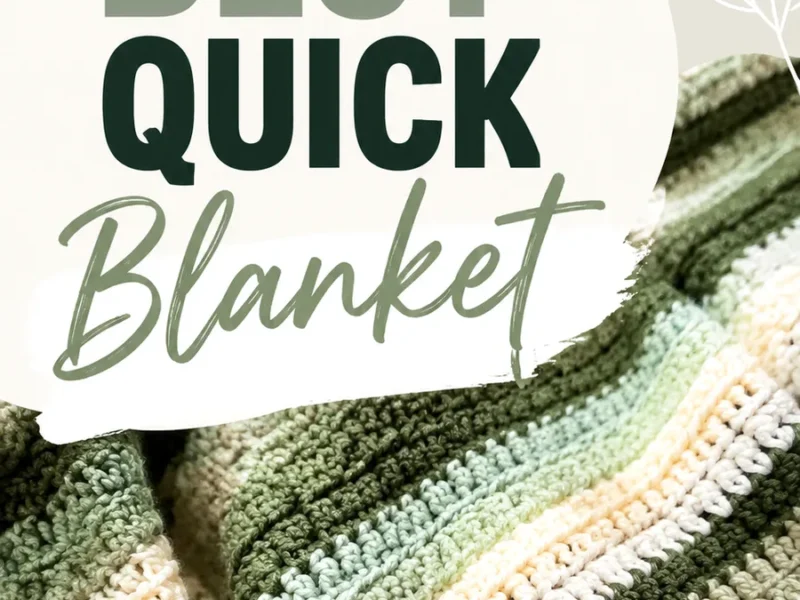
This blanket has the feel of a quiet afternoon, the kind where nothing needs to happen fast. Sage green, cream, and deep olive stack up in wide horizontal bands that read as calm rather than busy. The ribbed texture row breaks up the smooth hdc fabric just enough to catch the light. It is the sort of piece that settles into a room instead of announcing itself.
Your hands spend most of this project doing one thing well: half double crochet, row after row, turn after turn. There is a single ribbed hdc row to add texture, plus three color changes to track at the ends of rows. Nothing here asks for shaping or increases, just steady rows and the patience to keep going until the rectangle is long enough.
Finished, this becomes a throw that drapes easily over the arm of a sofa or folds at the foot of a bed. The single crochet border holds the edges flat so the piece keeps its shape through regular use. Set it across a reading chair or layered over a neutral couch, and the sage, cream, and olive stripes do the work of warming up the room without adding clutter.
- You start by chaining a long foundation row and working half double crochet across to set the width.
- Rows of hdc build up in sage green until the first stripe reaches its planned depth.
- More hdc rows continue in cream before the color changes again to deep olive for the next stripe.
- You keep repeating hdc rows and color changes until the rectangle reaches its full length.
- Once the panel is complete, you work a round of single crochet around all four edges.
- A second single crochet round reinforces the border and squares off each corner with extra stitches.
- Fastening off and weaving in the ends finishes the blanket before blocking.
On the desk
Color A
- Soft sage green, approximately 700 yards (640 meters)
Color B
- Cream, approximately 650 yards (594 meters)
Color C
- Deep olive green, approximately 650 yards (594 meters)
- 5.5 mm crochet hook (US I-9)
- Yarn needle for weaving ends
- Scissors
- Blocking mats or clean towels for shaping
Stitch shorthand
- ch — chain
- hdc — half double crochet
- sl st — slip stitch
- st — stitch
- yo — yarn over
- RS — right side
- WS — wrong side
- UK note — US half double crochet is called half treble crochet in UK terminology.
Easy striped half double crochet blanket for beginners
Main Pattern
The blanket is worked flat from the bottom edge upward. Turning chains do not count as stitches. Each row begins in the first stitch of the previous row. Color changes happen at the end of selected rows to create wide horizontal stripes.
- Foundation Row
With Color A, chain 168.
- Row 1
Hdc in the second chain from hook and each chain across. Turn. (167 hdc)
- Rows 2–8
Ch 1, hdc across. Turn. (167 hdc)
- Row 9(167)
Change to Color B. Ch 1, work ribbed half double crochet across. Turn. (167 stitches)
- Rows 10–16
Ch 1, hdc across. Turn. (167 hdc)
- Rows 17–24
Change to Color C. Ch 1, hdc across. Turn. (167 hdc)
- Rows 25–32
Change to Color A. Ch 1, hdc across. Turn. (167 hdc)
- Rows 33–40
Change to Color B. Ch 1, hdc across. Turn. (167 hdc)
- Rows 41–48
Change to Color C. Ch 1, hdc across. Turn. (167 hdc)
- Rows 49–120
Continue repeating the eight-row stripe sequence: eight rows Color A, eight rows Color B, and eight rows Color C until the blanket reaches approximately 60 inches (152 cm) in length.Fasten off after the final row and weave in all loose ends.
Border Instructions
Join Color A with a slip stitch in any corner.
- Round 1
Ch 1, work single crochet evenly around all four edges. Place 3 single crochet stitches in each corner. Join with a slip stitch.
- Round 2
Ch 1, work single crochet around the entire blanket. Place 3 single crochet stitches in each corner. Join with a slip stitch.Fasten off and weave in ends.
Project Details
Skill Level Beginner Finished Size Approximately 48 x 60 inches (122 x 152 cm)
Yarn Worsted weight yarn, category 4, approximately 2,000 yards (1,830 meters) total Hook 5.5 mm crochet hook, US I-9 Gauge
14 half double crochet stitches x 10 rows = 4 x 4 inches (10 x 10 cm)
Terminology US crochet terms
Pro Tip Before starting the blanket, crochet a small gauge swatch. A slight difference in tension can significantly change the final blanket size, especially for larger projects.
Special Stitch
Ribbed Half Double Crochet: Work a half double crochet stitch into the third loop behind the stitch from the previous row. This creates a subtle horizontal ridge and textured fabric.
Where it goes
- As a sofa throw folded over one arm, paired with plain linen cushions so the stripes stay the focus.
- the foot of a bed as a layering blanket, paired with solid cream or olive bedding for a calm palette match.
- As a lap blanket for a reading chair, paired with a wooden side table and a warm mug.
- As a housewarming gift for someone settling into a new place, since the sage and cream palette works with most decor.
Color ideas
- Sage Meadow (as written) Sage green forms the base rows, cream carries the ribbed texture row and the stripe that follows it, and deep olive takes the next wide band, repeating that order up the panel.
- Olive Lead Start the base rows in deep olive instead of sage, let cream still carry the ribbed texture row, and bring sage green in as the accent stripe that follows, swapping the original order.
Care
Check the yarn band before washing, since worsted weight covers everything from acrylic to wool and each fiber behaves differently in water.
If your yarn is a washable acrylic or blend, a gentle machine cycle inside a mesh bag is usually fine; if it is a natural fiber, hand wash in cool water instead.
Dry the blanket flat on a towel rather than hanging it, since a large wet panel will stretch under its own weight.
Assembly
- Step 1 After completing the blanket, gently block the fabric to improve stitch definition and help the edges relax. Lay the blanket flat, lightly mist with water, and shape the corners evenly before allowing it to dry.
- Step 2 For best results, use yarn care instructions that match your chosen fiber. Many soft acrylic and washable blends can be machine washed, while natural fibers may require more delicate handling.
Easy to get wrong
Losing count across such a wide row
Drop a stitch marker every so often across the row so a miscount only costs you a short section, not the whole row.
Blurring the ribbed texture row
Slow down on the ribbed hdc row and work each stitch as the pattern specifies, so the ridge stands apart from the plain hdc rows around it.
Uneven corners on the border
Place the extra single crochet stitches into each corner on both border rounds so the rectangle stays square instead of pulling into a diamond shape.
Visible bumps at color changes
Change colors at the final yarn over of the previous stitch for smoother transitions between stripes.
Blanket turns out the wrong size
Check your gauge before beginning the full blanket, and measure your work after several stripe sections since large crochet blankets grow quickly and can produce surprises in the final dimensions.
Between the songs
- What I love about this one is how much texture you get from stitches that are genuinely easy to repeat. Half double crochet alone gives a fabric thicker than single crochet, and that one ribbed row breaks the surface into soft ridges without a single new stitch to learn. Watching the stripes stack up in sage green, cream, and deep olive keeps the long rows from feeling monotonous, since every color change marks real progress. The two-round single crochet border, with extra stitches tucked into each corner, squares off the whole rectangle and gives it a clean, finished edge. It is satisfying because every part of it rewards consistency rather than skill you do not have yet.
Listener questions
Can I make this blanket a different size?
Yes, you can lengthen or shorten the foundation chain to change the width, keeping it a multiple that matches the stitch pattern. Add or remove hdc rows to adjust the overall length as well.
Do I need to know the ribbed half double crochet stitch before starting?
It is the one special stitch in this pattern, and it only shows up on a couple of rows. Once you work it the first time, the second repeat goes much faster.
Can I substitute different colors for the sage, cream, and olive?
Yes, since the stripe effect depends on contrast between the three yarns, not on these exact shades. Pick three colors with enough value difference so the stripes still read clearly against each other.
Why does the pattern use half double crochet instead of single crochet?
Half double crochet builds a thicker fabric faster than single crochet, which matters on a large throw since it reduces how many rows you need. It also gives the ribbed texture row more room to create visible ridges.
How much yarn do I actually need to finish the whole blanket?
The materials list calls for about 700 yards of sage green and about 650 yards each of cream and deep olive, for roughly 2,000 yards total. Buy a little extra if you plan to adjust the size.
Original pattern: https://duniarecipe.com/easy-crochet-blanket-patterns-for-beginners-quick-cozy-blanket-tutorial/
About the Author

Marisol QuinteroWho runs Crochet Obsessed, why a stitch count sits at the end of every round, how a pattern gets written here, and the things this site will never do.
More Patterns
- IntermediateNo. 01

Rose Granny Square Tote Crochet Pattern
Rose granny square tote crochet pattern made from 18 dimensional rose squares for a sturdy, romantic everyday bag.
- IntermediateNo. 02
Tropical octopus baby blanket crochet pattern with appliqués
Tropical octopus baby blanket crochet pattern: a cream filet base with coral and turquoise octopus appliqués, leaves, and…
- IntermediateNo. 03
Sunny lemon couple amigurumi crochet pattern
Sunny lemon couple amigurumi crochet pattern with embroidered slices and safety eyes for a cheerful handmade shelf pair.