- LevelBeginner
- Time6-8 Hours
- Hook4 mm
- YarnDK
About This Pattern
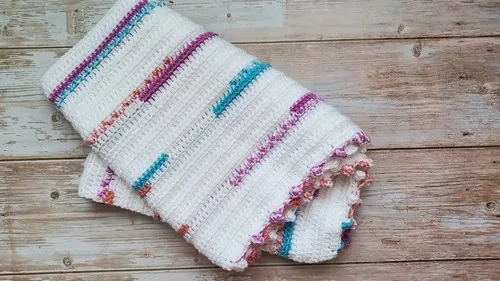
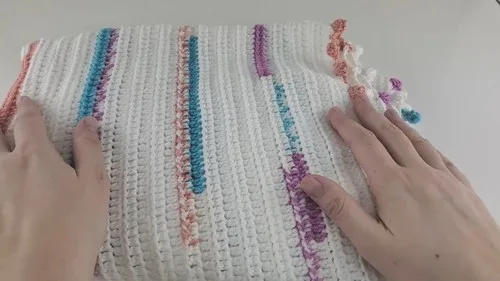
This pattern creates a soft, snuggly baby blanket built almost entirely from one simple stitch, the extended half double crochet, worked back and forth in long flat rows. What makes it special is the built-in stripe design, six rows of soft white main color followed by two playful rows of multicolor contrast yarn, giving the blanket movement and personality without any complicated colorwork or charts. It's perfect for new crocheters who want a project that feels productive from the very first row, and for anyone hunting for a meaningful handmade baby shower gift.
The key technique here is the extended half double crochet, a slightly taller, cushier cousin of the regular half double crochet that gives the fabric a lovely drape without a lot of holes. You'll also practice a clean color-change technique, dropping one yarn and picking up the other mid-stitch so the transition stays neat on both sides. This is a true beginner-to-confident-beginner project, expect to spend somewhere in the range of six to eight hours total, spread across a few relaxed evenings.
The finished blanket lands in that sweet spot of generous stroller or crib size, thick enough to feel substantial but still soft and breathable thanks to the DK weight yarn. The repeating stripe pattern gives it a modern, gender-neutral look that reads as thoughtfully handmade rather than fussy. It folds beautifully for gifting, works equally well tucked into a nursery basket or wrapped around a newborn for photos, and it's the kind of blanket that gets passed down and remembered.
- Chain a length divisible by six plus two to set your blanket's eventual width.
- Work your first row of extended half double crochet across the entire starting chain.
- Continue working six rows of extended half double crochet in the Main Color yarn.
- Work two full rows in the Contrast Color to create a stripe accent.
- Drop the Contrast Color and pick Main Color back up to continue the base pattern.
- Repeat the six Main Color rows and two Contrast Color rows until the blanket reaches your desired length.
- Finish by weaving in every yarn end securely, changing direction once for a lasting hold.
Materials
- DK weight yarn (King Cherished Baby DK)
- 4 mm crochet hook
- Main Color (MC): 3 balls (White)
- Contrast Color (CC): 1 ball (Multicolor)
- Scissors and tapestry needle
Crochet Abbreviations
- EHDC
- Extended Half Double Crochet
- MC
- Main Color
- CC
- Contrast Color
- DC
- Double Crochet
- Ch
- Chain
Easy Striped Baby Blanket Pattern For Beginners
Main Pattern
Extended Half Double Crochet (EHDC) Stitch: Yarn over. Insert hook into the third chain from the hook. Yarn over, pull through (3 loops on hook). Yarn over, pull through one loop only. Yarn over, pull through all 3 loops.
Starting Chain: Decide on the total number of chain stitches (divisible by 6 plus 2). Example: 140 chains (138 + 2). Make a slip knot and chain the required number.
- Row 1(138)
Skip the first two chains (turning chains). Work 1 EHDC into the third chain from the hook and in each chain across. You should have 138 stitches if following the example.
- Row 2-6
(Main Color): Chain 2 and turn your work. Skip the turning chains. Work 1 EHDC into each stitch across the row. Repeat until you have completed 6 rows in Main Color.
- Row 7-8
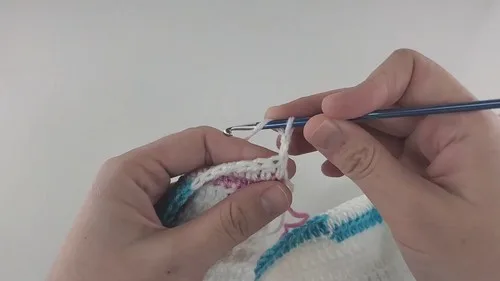
(Contrast Color): On the last EHDC of Row 6, stop with 3 loops on the hook. Drop MC, yarn over with CC, and pull through all loops. Chain 2 in the new color and tie both ends in a double knot. Work 2 rows in Contrast Color without cutting the Main Color yarn.
- Row 9
(Back to Main Color): On the last EHDC of the CC row, stop with 3 loops on the hook. Drop CC, yarn over with MC, and pull through all loops. Continue with EHDC pattern in MC. Cut CC and weave in the end later.Stripe Repeat: Repeat the sequence of 6 rows Main Color and 2 rows Contrast Color until the blanket reaches the desired length.
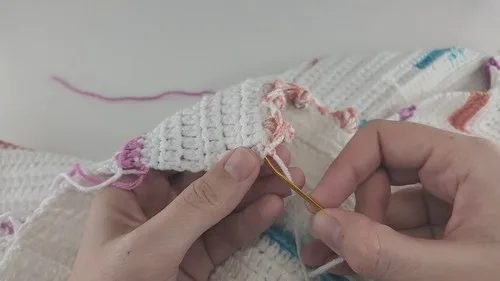
Bubble Stitch Border: Attach the Contrast Color yarn to the last stitch of your final row. Chain 2 and turn your work. Skip 3 stitches and in the 4th stitch, work a Bubble Stitch: Make 5 Double Crochet in the same stitch. Remove hook, insert it into the first DC, place the loop back, and pull through. Chain 2, skip 2 stitches, and slip stitch into the next stitch. Continue the sequence (Ch 2, skip 2, Bubble Stitch) to the end.
Optional: Border Along Long Sides: Chain 2, skip 1 row, insert hook between the 1st and 2nd row to start a corner. Chain 2, skip about 1.5 rows, and slip stitch into the third row to continue evenly along the sides.
More photos
Assembly Instructions
- Step 1 Cut yarn and pull the end through the last loop to secure.
- Step 2 Thread the tapestry needle and weave the ends into the same color section.
- Step 3 Change direction once for security and trim excess yarn.
- Step 4 Repeat for all remaining ends.
Important Notes
- Decide on your finished blanket size before you chain, since this pattern is written to be flexible, just make sure your total chain count is divisible by six plus two, like the sample 140 chains.
- Work a swatch of about 20 stitches and a few rows first to check your gauge, this helps you predict final size before committing to your full chain length.
- Tie both yarn ends in a loose double knot right at the color change to hold tension steady while you keep working, you can trim and weave these in properly at the end.
- Don't cut your Contrast Color until you've worked both of its rows, since it needs to be picked back up for texture consistency if you choose to alternate multicolor skeins.
- Block your finished blanket gently once all ends are woven in, DK weight yarn responds well to a light steam or spray block to even out any curling along the edges.
Common Mistakes and Fixes
- Starting with a chain count that isn't
Before you begin, do the math on your desired chain length so the multiple of six plus two lines up, this keeps your EHDC stitch count consistent across every row.
- Working into the wrong chain on Row 1.
Remember to skip the first two turning chains and place your first EHDC into the third chain from the hook, not the second, or your stitch count will be off from the start.
- Cutting the Main Color yarn during the Contrast Color rows.
Leave the Main Color yarn attached and simply carry it up the side while you work the two Contrast Color rows, this saves you extra ends to weave in later and keeps tension even.
- Pulling the color change too tight or too loose.
When you drop one color and pull the new color through all three loops, keep your tension relaxed and consistent, a too-tight pull puts a visible pucker right at the stripe line.
- Losing count of your row repeats.
Keep a small tally or use a row counter to track your six Main Color rows and two Contrast Color rows, since the repeating pattern is easy to lose track of over a long blanket.
- Weaving in ends without securing them properly.
Always change direction at least once while weaving each end through the fabric and trim only after that second pass, otherwise ends can work themselves loose with washing.
Variations
- The beauty of this blanket is how easily it adapts to whatever look you're after. For a soft pastel nursery, try swapping the white Main Color for a pale blush pink or sage green DK yarn, then choose a Contrast Color multicolor skein that pulls those same tones together, it instantly feels custom rather than generic. If you want something bolder, go with a deep navy or charcoal Main Color and a bright rainbow-flecked Contrast Color for a striking, modern nursery statement piece. You can also flip the ratio, working fewer Main Color rows and more Contrast rows, for a blanket that reads as more colorful overall. Size is completely flexible since you're choosing your own starting chain, so for a lovey-sized security blanket, chain something in the 50-60 stitch range, and for an oversized stroller blanket that lasts well into toddlerhood, go up to 170 or more chains, just keep it divisible by six plus two so your stitch pattern lines up. Yarn substitution is easy too, any DK weight yarn works beautifully here, cotton-acrylic blends add extra washability for spit-up duty, while a merino DK adds luxury softness for a special gift. If you want to experiment with texture, try alternating your Contrast Color rows between two different multicolor skeins instead of one, so no two stripe sections look quite the same. You could even add a simple contrast border around the entire finished piece using single crochet in your Contrast Color to frame the stripes and give the edges a tidy, finished look.
- I fell for this blanket the moment I saw how much personality those little contrast stripes add to an otherwise simple project. The extended half double crochet stitch is genuinely satisfying to work up, it's taller than a regular half double crochet so your rows grow quickly, but it still gives you that dense, cuddly fabric babies love to be wrapped in. There's something so calming about settling into row after row of Main Color, knowing a little burst of Multicolor is coming up soon to break the rhythm. The color-change technique is one of those skills that feels intimidating until you try it, then suddenly you're doing it without thinking twice. I also love that you're not committed to a single size, since the pattern is written to let you decide your chain length, so it grows with your yarn stash or your intended recipient. Weaving in ends is genuinely the only fussy part, and even that becomes meditative once you get a rhythm going with your tapestry needle. This is the pattern I hand to every friend who says they want to crochet something meaningful but feels nervous about starting.
Frequently Asked Questions
How much yarn do I actually need for this blanket?
The pattern calls for 3 balls of DK weight Main Color and 1 ball of Contrast Color, but your exact yardage depends on how many chains you start with and how long you make the blanket. Buy an extra ball of Main Color if you're going for an oversized stroller or crib size.
What size hook should I use, and does it matter which brand?
You'll want a 4mm crochet hook for this pattern, which pairs well with DK weight yarn to create a cushiony, dense fabric. The brand of hook doesn't matter, just make sure it feels comfortable in your hand since you'll be working many rows in the same stitch.
Is the extended half double crochet stitch hard to learn?
Not at all, it's just one extra yarn over and pull-through compared to a regular half double crochet, and most beginners pick it up within the first few stitches. The pattern's stitch guide walks you through each step slowly so you can practice before diving into the full rows.
How do I know when my blanket is the right length?
Since the pattern repeats the six-row Main Color and two-row Contrast Color sequence, you simply keep repeating that block until the blanket measures your desired length. Lay it flat periodically and measure to check your progress against your goal size.
Original pattern: https://crocheteverything.com/how-to-crochet-baby-blanket-pattern-for-beginners/
About the Author

Marisol QuinteroWho runs Crochet Obsessed, why a stitch count sits at the end of every round, how a pattern gets written here, and the things this site will never do.
More Patterns
- IntermediateNo. 01

Slouchy everyday beanie worked flat in half double crochet
Crochet beanie pattern for a slouchy everyday look worked flat with hdc rows, then seamed into a soft,…
- IntermediateNo. 02
Crochet amigurumi doll with dress, shoes, and hat
Crochet amigurumi doll pattern with dress, shoes, and hat details for a soft, huggable keepsake you build one…
- IntermediateNo. 03
Chunky moss stitch crochet sweater with raglan-free shoulders
Chunky crochet sweater pattern using moss stitch, worked flat with a 10mm hook for a soft, fast, cool-weather…