- LevelIntermediate
- Time4-6 hours
- Hook4.50 mm
- YarnWorsted
About This Pattern
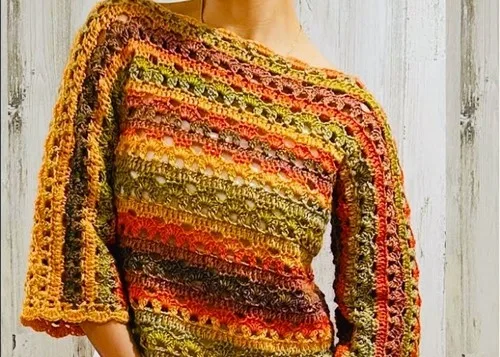
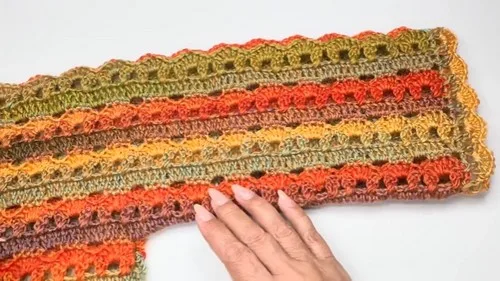
This one has that first-cool-morning feeling, the kind where you reach for something with a bit more texture than your usual pullover. The crossed stitches catch the light in a way that reads as woven rather than crocheted. It is a piece that looks more complicated than it actually is, which I love in a project.
Your hands get busy but never bored. You are chaining, skipping, crossing back over a stitch, then opening up into a little arch of five double crochets before you settle again. It keeps you present in the row instead of letting your mind wander off, which for me is half the reason I pick up a hook.
Once it is off the hook and blocked flat, this sweater holds a shape on a hanger that actually looks like a sweater, not a floppy square. Draped over a chair by the door or folded on a shelf, the crossed stitch texture shows even at rest. It is the kind of piece that makes a plain room look a little more lived in.
This design works well for everyday wear and can be easily adjusted in length or width to suit different body sizes and personal style preferences. Whether you choose soft neutrals or warm autumn shades, this sweater is a versatile addition to any handmade wardrobe.
- Start with a foundation row of double crochet across your starting chain to set the width.
- Work a crossed stitch row where you skip ahead, come back, and lock two stitches into an X shape.
- Repeat the chain-one and skip-two sequence across so the crosses line up in a steady band.
- Turn and work an arch row, tucking five double crochets into each chain-one space from the row before.
- Cycle through the same four rows again for the body and sleeves until each panel is complete.
- Lay the front and back panels together with right sides facing before joining.
- Slip stitch the arches of the front to the crossed stitches of the back along each shoulder.
- Leave the center opening unjoined for the neckline before weaving in your ends.
On the desk
- Yarn weight 3 yarn with a soft acrylic and wool blend
- 4.50 mm crochet hook
- Stitch multiple of 6 plus 3
- Medium size starts with 72 plus 3 chains
Stitch shorthand
- ch — chain
- sl st — slip stitch
- sc — single crochet
- dc — double crochet
Textured crossed stitch sweater with arch rows
Main Pattern
Pattern Notes The sweater uses a four row repeat throughout the body and sleeves. The same stitch pattern is used to keep the design consistent and beginner friendly.
- Round 1
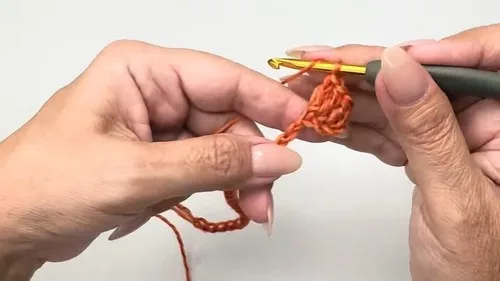
Foundation Row Make double crochet in the fourth chain from the hook. Work one double crochet in every chain across.
- Round 2
Crossed Stitch Row Chain three to count as the first double crochet. Skip the first stitch and make one double crochet in the next stitch. Make one double crochet back into the skipped stitch to form a crossed stitch. Chain one and skip two stitches. Make one double crochet in the next stitch. Make one double crochet back into the previous skipped stitch. Repeat this sequence across the row. End with one double crochet in the last stitch.
- Round 3
Arch Row Chain one and turn your work. Make one single crochet in the first stitch. In the next chain one space work five double crochets. Make one single crochet in the next chain one space. Work five double crochets in the following chain one space. Repeat across the row.
- Round 4
Setup Row Chain four to count as one double crochet and chain one. Skip the first double crochet of the arch below. Make one single crochet in each of the three center double crochets of the arch. Chain three. Make one single crochet in the three center double crochets of the next arch. Repeat across the row. End with chain one and one double crochet in the final stitch.Repeat rows one through four until the piece measures approximately thirty centimeters.
At the end of a row add forty eight chains or any multiple of six on one side. Work across the stitches. Add the same number of chains on the other side.Continue working the four row repeat across the full width. Crochet until the sleeve depth reaches about eighteen centimeters.Finish the front panel after completing a row three arch row. Make a second identical panel for the back. Finish the back panel on a row two crossed stitch row.
More shots
Where it goes
- A cozy layering piece for a porch morning with coffee, paired with jeans and worn over a plain tee.
- An easy throw-on for a weekend farmers market trip, layered over a lightweight cotton dress.
- A relaxed studio or work-from-home piece for chilly rooms, paired with wool socks and a soft scarf.
- A textured statement layer for a casual evening out, worn open over a simple camisole.
Color ideas
- Warm oat and rust Oat for the foundation and crossed stitch rows across the whole body, with rust worked into the arch rows so the open fans pop against the crosses.
- Soft charcoal and cream Charcoal for the main body panels, cream reserved for the sleeves, so the crossed stitch texture reads differently on each piece.
Care
Hand wash in cool water since this is an acrylic and wool blend, and avoid wringing the fabric to protect the crossed stitch texture.
Lay the sweater flat on a towel to dry, gently easing the arch rows back into shape while it is still damp.
Fold rather than hang for storage, since the open arch spaces can stretch out of shape on a hanger over time.
Assembly
- Step 1 Place the front and back panels together
- Step 2 Join the shoulders by slip stitching the arches of the front panel to the crossed stitches of the back panel
- Step 3 Leave a twenty four centimeter opening in the center for the neckline
- Step 4 Turn the sweater inside out. Use slip stitches to close the sides and the underarm sections of the sleeves.
- Step 5 Finish the sleeve edges with one round of crossed stitches. Add one round of arches for a decorative cuff detail.
Easy to get wrong
Losing track of which stitch is skipped
Mark the skipped stitch with a locking stitch marker before you cross back into it. This keeps the X shape even instead of drifting off by one stitch as you go.
Crowding the arch row spaces
Make sure each group of five double crochets sits inside the chain-one space and not into the stitch itself. A crowded arch flattens the open texture that makes this row stand out.
Joining shoulders with the wrong edges matched
Double check you are slip stitching the arches of the front panel specifically to the crossed stitches of the back panel. Mixing up which row faces which throws off the shoulder line.
Between the songs
- What makes this satisfying is the crossed stitch row doing real structural work, not just decoration. You skip ahead, come back for the skipped stitch, and the fabric locks into a woven diagonal that a straight row of double crochet could never give you. Then the arch row breaks that rhythm completely, opening five double crochets into a chain-one space so the texture shifts from tight crosses to soft open fans. Working the same four-row repeat through the body and sleeves means you master the sequence once and then just keep going, which builds real confidence. By the time you reach the shoulder seams, your hands know the pattern without you counting every step.
Listener questions
Do I need to know the crossed stitch technique before starting this sweater?
It helps to practice the skip-and-cross sequence on a small swatch first. Once you have worked it a few times, the chain-one and skip-two rhythm becomes easy to repeat across a full row.
Can I use a different fiber than the acrylic and wool blend listed?
You can substitute another worsted weight yarn as long as it works well at a 4.50 mm hook. Keep in mind the softness of the wool blend is part of what makes the finished texture drape nicely.
Why does the pattern repeat every four rows?
The four-row repeat alternates the crossed stitch row with the arch row, which is what creates the contrast between tight woven texture and open fan texture. Repeating it through the body and sleeves keeps the whole sweater visually consistent.
How do I know my stitch multiple is correct before starting?
Check that your starting chain works out to a multiple of six plus three, matching the medium size chain count listed in the materials. Getting this right up front keeps the crossed stitch and arch rows lining up properly across every row.
What is the neckline opening for exactly?
The center opening left unjoined at the shoulders becomes the neckline once the front and back panels are seamed together. It is worked at the same time as the shoulder join, not added afterward.
Original pattern: https://crocheteverything.com/cozy-crochet-autumn-sweater-pattern-free-with-stunning-texture/
About the Author

Marisol QuinteroWho runs Crochet Obsessed, why a stitch count sits at the end of every round, how a pattern gets written here, and the things this site will never do.
More Patterns
- IntermediateNo. 01

Slouchy everyday beanie worked flat in half double crochet
Crochet beanie pattern for a slouchy everyday look worked flat with hdc rows, then seamed into a soft,…
- IntermediateNo. 02
Crochet amigurumi doll with dress, shoes, and hat
Crochet amigurumi doll pattern with dress, shoes, and hat details for a soft, huggable keepsake you build one…
- IntermediateNo. 03
Chunky moss stitch crochet sweater with raglan-free shoulders
Chunky crochet sweater pattern using moss stitch, worked flat with a 10mm hook for a soft, fast, cool-weather…