- LevelIntermediate
- Time4-6 hours
- Hook2.5 mm
- YarnSport
About This Pattern
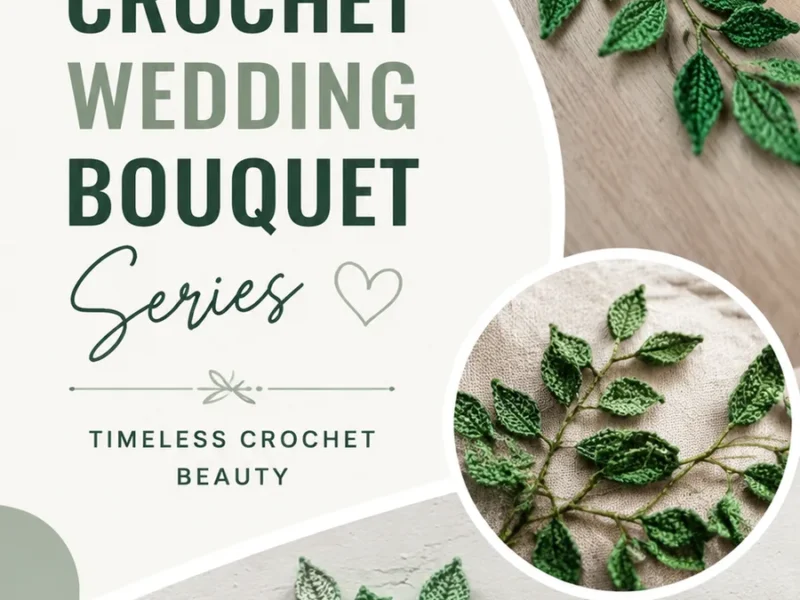
This one sits quiet and green on the table, no big blooms shouting for attention. It's the kind of piece that fills in around the showier flowers, the way real greenery does in an actual bouquet. I like projects that don't try to be the main event.
Your hands will spend most of their time on small, repeated increases, the kind that turn a flat chain into a leaf with a point at each end. There's a second skill in there too, making a cord and wrapping it tight around wire so the stem holds a bend. Neither move is hard, but both reward patience.
Set a finished branch in a bud vase on a hallway table and it reads like something you'd clip from a garden, not something made with a hook. Lay a few along a window ledge and they catch light instead of casting shadow. It's a quiet decor piece that never needs water.
Finished size runs approximately 14 inches (35.5 cm) of branch length, worked to a gauge of about 24 single crochet stitches by 28 rows per 4 inches (10 cm). Skill level is confident beginner to intermediate.
Important: take time to block each leaf before assembly, since properly shaped pieces create a more realistic botanical appearance.
Pro tip: choose yarn with a smooth surface rather than a fuzzy one, since fuzzy fibers can hide the stitch details that make small leaves look realistic.
- Chain a foundation length and work the first leaf row across both sides to shape the pointed ends.
- Turn and work a second row with increases concentrated at the tip to widen the leaf.
- Work a final plain row across all stitches to even out the edge before fastening off.
- Leave a long tail on each leaf so you have something to sew with later.
- Slip stitch a narrow cord directly around a length of floral wire to build the flexible stem.
- Wrap and secure the yarn ends at the stem so the cord stays tight against the wire.
- Attach short chain sections along the main stem to suggest small branching twigs.
- Arrange the leaves and stem by hand, then steam or mist lightly so the shapes set without flattening.
On the desk
- Sport weight cotton yarn in green, approximately 80 yards (73 meters)
- 2.5 mm crochet hook (US B-1)
- Small amount of floral wire for shaping the stem
- Yarn needle
- Scissors
- Stitch marker
- Fabric blocking pins and spray bottle for shaping
Stitch shorthand
- ch — chain
- sc — single crochet
- hdc — half double crochet
- dc — double crochet
- sl st — slip stitch
- inc — increase, 2 stitches in one stitch
- st — stitch
- rep — repeat
- Special Note — This pattern uses standard US crochet terminology. The UK equivalent of sc is double crochet and hdc is half treble crochet.
Crochet leafy branch for wedding bouquet greenery
Leaf Pattern (Make 12 Leaves)
Make 12 leaves total. Each leaf is worked in rows from a foundation chain, and the turning chain does not count as a stitch. Begin with ch 8.
- Row 1
Starting in 2nd ch from hook, sc in next 3 ch, hdc in next 2 ch, 5 dc in last ch. Working along the opposite side of foundation chain, hdc in next 2 spaces, sc in next 2 spaces. (14 sts)
- Row 2
Ch 1, turn. Sc in next 3 sts, hdc in next 2 sts, 2 dc in each of next 5 sts, hdc in next 2 sts, sc in next 2 sts. (19 sts)
- Row 3(19)
Ch 1, turn. Sc across all stitches. (19 sts) Fasten off, leaving a long tail for attaching.
Stem Pattern
Cut a piece of floral wire approximately 16 inches (40.5 cm). Ch 35 loosely around the wire.
- Row 1(34)
Starting in 2nd ch from hook, sl st in each chain around the wire. (34 sl sts)Wrap the crocheted cord around the wire and secure the yarn ends.
Create small branch sections by crocheting additional short chains and attaching them along the main stem.
Where it goes
- A bouquet component that stands in for fresh greenery alongside crochet roses or fabric blossoms.
- A centerpiece filler laid across a table runner with candles or small vases.
- A standalone decorative branch propped in a narrow vase on a shelf or mantel.
- A boutonniere or corsage accent pinned alongside a single crochet flower.
Color ideas
- Classic garden green Work every leaf and the stem cord in the same sport weight green so the branch reads as one continuous plant.
- Two-tone foliage Make the leaves in a deeper green and the stem and small branch chains in a lighter green for contrast between foliage and structure.
- Wedding theme shades Swap the green for ivory, blush, lavender, or sage yarn to match different wedding color themes.
Care
Hand wash only if needed, using cool water and mild soap, since sport weight cotton holds its shape best without machine agitation. Always test the yarn first.
Lay the branch flat to dry and use the mist-and-reshape approach from the pattern rather than heavy blocking, so the leaves keep their slight dimension.
Store the finished piece away from direct sunlight and moisture, flat or loosely curved in a clean container or display vase, so the floral wire stem keeps its arranged bend.
Assembly
- Step 1 Block each leaf lightly with water and shape the pointed ends.
- Step 2 Arrange six leaves on each side of the stem, spacing them approximately 1 to 2 inches apart.
- Step 3 Use the yarn tails to sew each leaf securely around the stem.
- Step 4 Wrap green yarn around attachment points to create a natural branch appearance.
- Step 5 Bend the wire gently to create the desired bouquet shape.
- Step 6 Weave in all remaining yarn ends.
- Step 7 After assembly, gently reshape the branch by hand. If needed, apply light steam or mist the leaves and allow them to dry flat. Avoid heavy blocking because small crochet leaves should maintain slight dimension and movement.
Easy to get wrong
Leaves look flat
Add blocking and shape the center vein gently with your fingers.
Stems feel too soft
Add floral wire reinforcement for better positioning.
Leaves twist
Check your stitch tension and avoid pulling stitches too tightly.
Assembly looks uneven
Lay out all pieces before sewing to balance spacing.
Between the songs
- The satisfaction here is in the shaping. Working sc, hdc, and dc across one row, then doubling up with 2 dc increases on the return row, is what gives each leaf its pointed botanical outline instead of a flat oval. I love watching a plain foundation chain turn into something with a visible spine and a raised center just from stitch placement. The stem work is its own small win: slip stitching a cord around floral wire and wrapping it tight teaches you how crochet fabric can grip and hold a shape. By the time the branch is reshaped by hand, you've practiced firm single crochet, taller half double crochet, and wire-wrapped assembly all in one small project.
Listener questions
Can I use a different yarn weight for this branch?
The pattern is written for sport weight cotton, which gives the firm, defined fabric the leaves need. A heavier yarn will make the leaves bulkier and change the finished branch length.
Why does the stem need floral wire instead of just a crochet cord?
The slip stitch cord alone has no structure, so wrapping it around floral wire is what lets you bend and position the branch. Without the wire, the stem would flop rather than hold an arranged shape.
How many leaves should I make for a full bouquet component?
The pattern calls for 12 leaves total, with six arranged on each side of the stem and spaced approximately 1 to 2 inches apart.
Is this a good project if I'm newer to crochet?
The pattern is listed as confident beginner to intermediate, so basic sc, hdc, and dc skills are enough. The trickiest part is the wire-wrapped stem, which just takes a steady hand and firm tension.
Can I make the branch longer than the finished size given?
Yes, the notes say to add more chains before slip stitching the stem cord to extend the branch length. Just keep the same firm tension around the wire so the longer stem still holds its shape.
Original pattern: https://duniarecipe.com/crochet-wedding-flowers-ideas-handmade-bridal-bouquet-floral-decor-inspiration/
About the Author

Marisol QuinteroWho runs Crochet Obsessed, why a stitch count sits at the end of every round, how a pattern gets written here, and the things this site will never do.
More Patterns
- IntermediateNo. 01

Rose Granny Square Tote Crochet Pattern
Rose granny square tote crochet pattern made from 18 dimensional rose squares for a sturdy, romantic everyday bag.
- IntermediateNo. 02
Tropical octopus baby blanket crochet pattern with appliqués
Tropical octopus baby blanket crochet pattern: a cream filet base with coral and turquoise octopus appliqués, leaves, and…
- IntermediateNo. 03
Sunny lemon couple amigurumi crochet pattern
Sunny lemon couple amigurumi crochet pattern with embroidered slices and safety eyes for a cheerful handmade shelf pair.