- LevelIntermediate
- Time4-6 hours
- Hook5 mm
- YarnWorsted
About This Pattern
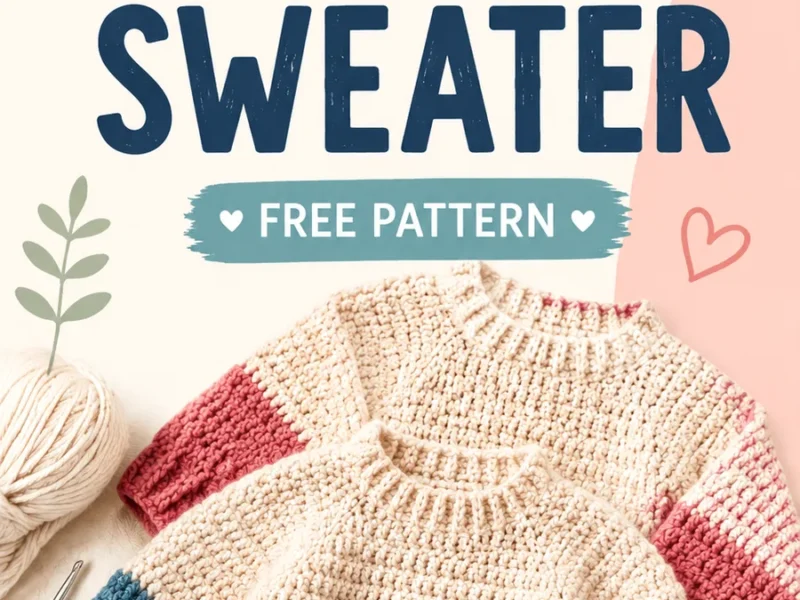
This one has the mood of a Sunday morning with the heat turned up just enough. It is not fussy or fancy, just a sweet little pullover that looks like it was made with care. The contrast cuffs give it a bit of personality without shouting about it.
Your hands get a steady job here: rows of hdc that build up fast, then a little focus work shaping the shoulders on the front panel. There is a short stretch of counting stitches when you split for the neckline, and a couple of gentle decrease rows on the sleeves. None of it is tricky, it just asks you to pay attention for a few rows at a time.
Picture it folded on a shelf in the nursery, main color body with the contrast peeking out at the cuffs. It reads as handmade in the best way, textured and substantial rather than thin or flimsy. On a baby, it sits like a real little sweater, not a costume piece.
- Start with the back panel, working straight rows of hdc until the piece reaches the length given for the body.
- Move to the front panel, repeating the same base rows before splitting the stitches to shape the two shoulders.
- Work each shoulder section separately for a few rows, then fasten off and mirror the shaping on the other side.
- Set the panels aside and work both sleeves flat, starting wide and tapering with the decrease rows near the top.
- Join main and contrast yarns as directed to build the ribbed hem, cuffs, and neckline finishing details.
- Seam the front and back panels together at the shoulders and sides, leaving the armholes open for the sleeves.
- Set each sleeve into its armhole and sew it in place using the yarn needle.
- Weave in every end, then wash and reshape the finished sweater before it goes into the drawer.
On the desk
- Worsted weight yarn in main color, approximately 300 yards (274 meters).
- Contrast color yarn for cuffs and color blocks, approximately 150 yards (137 meters).
- 5 mm US H-8 crochet hook.
- Yarn needle for sewing and weaving ends.
- Stitch markers.
- Scissors.
Stitch shorthand
- ch — chain
- sc — single crochet
- hdc — half double crochet
- sl st — slip stitch
- st — stitch
- sk — skip
- RS — right side
- WS — wrong side
Cozy panel pullover sweater pattern for baby boys
Back Panel
With main color yarn, ch 47.
- Row 1
Hdc in second ch from hook and across. Turn. (46 sts)
- Row 2
Ch 1, hdc across. Turn. (46 sts) Repeat Row 2 until the piece measures 7 inches (18 cm) from the beginning.For armhole shaping, fasten off and leave the panel flat. The shoulder shaping will be created during assembly.
Front Panel
Repeat the back panel instructions until the piece measures 6 inches (15 cm).
- Row 1
Work 16 hdc, leave center 14 stitches unworked, work remaining 16 hdc.Row 2: Turn and work across first shoulder section. Continue for 4 rows. Fasten off and repeat on the opposite shoulder.
Sleeves
Ch 31.
- Row 1
Hdc in second ch from hook and across. (30 sts)
- Row 2
Ch 1, hdc across. Turn. Repeat Row 2 for 22 rows.
- Decrease Row
Ch 1, hdc2tog, hdc across until last 2 sts, hdc2tog. (28 sts)Repeat decrease row every 5 rows twice more. (24 sts)
Fasten off.
Special Stitch
Ribbed stitch: Work single crochet stitches through the back loop only. This creates a stretchy rib texture for cuffs, neckline, and hem.
Ribbed Hem, Cuffs, and Neckline
Attach contrast yarn at the bottom edge.
Ch 8 for the ribbing strip.
Sc in second ch from hook and across. Sl st into the sweater edge.
Turn and work back loop only sc across the ribbing strip.
Repeat this process around the hem until the ribbing joins.
Repeat the same method around each sleeve cuff and neckline.
Where it goes
- An everyday layering piece for cooler indoor days, worn over a onesie or under a lightweight jacket.
- A handmade baby shower gift that pairs nicely with a matching hat or a pair of simple crochet booties.
- A photo-outfit sweater for seasonal family pictures, paired with plain pants so the color-block detail stays the focus.
- A keepsake piece for a new sibling, made to match an older child's sweater in the same contrast colors.
Color ideas
- Soft Blue and Cream Main color in soft blue for the back panel, front panel, and sleeves, with cream as the contrast color on the ribbed hem, cuffs, and neckline.
- Oat and Rust Main color in an oat neutral for the body panels and sleeve length, with rust as the contrast color worked into the cuffs and the neckline finish.
Care
Hand wash the finished sweater in cool water using a gentle detergent, following whatever the yarn label recommends for the main and contrast fibers.
Lay it flat on a towel while damp and gently reshape the panels and sleeves so the hdc texture settles evenly.
Store the sweater folded rather than hung, which keeps the shoulders and neckline from stretching out of shape over time.
Baby garments benefit from gentle care. Wash the finished crochet sweater according to the yarn label recommendations and reshape it while damp. Store it folded instead of hanging to help maintain the sweater shape.
Lightly block the finished sweater by shaping it flat and allowing it to dry naturally. Avoid stretching the fabric too aggressively. A gentle wash and careful shaping will help the stitches settle beautifully.
Assembly
- Step 1 Place front and back panels together with the right sides facing.
- Step 2 Sew shoulder seams using a mattress stitch or whip stitch.
- Step 3 Attach sleeves evenly along the armhole openings.
- Step 4 Sew side seams from the hem upward and continue along sleeve seams.
- Step 5 Weave in all yarn ends securely.
Easy to get wrong
Front panel split in the wrong spot
Count carefully before leaving the center stitches unworked for the neckline, since an uneven split throws off both shoulders. Use a stitch marker to mark the center point before you begin that row.
Sleeve decreases skipped or doubled
Keep a simple tally of your rows so the decrease rows land exactly where they belong rather than drifting. A row counter or a sticky note next to your work makes this easy to track.
Panels measured loosely before moving
Lay the piece flat and measure rather than eyeballing the length, since hdc can relax or tighten with tension changes. Check the measurement again after a quick steam or light block if your gauge runs tight.
Between the songs
- What I like about this one is the straightforward panel method: back, front, and sleeves worked flat, then joined, so you always know exactly where you are. The hdc fabric has a nice density to it, enough texture to look intentional without turning into a bulky mess. Splitting the front panel for the neckline and working each shoulder separately is the kind of small shaping detail that makes the garment feel tailored rather than just a tube with arms. And the contrast color yarn gives you an easy, low-risk way to make the piece feel designed, not just finished.
Listener questions
Do I need stitch markers for this pattern?
Yes, they are listed in the materials and are genuinely useful for marking the center point before splitting the front panel. They also help you track the start of each decrease row on the sleeves.
Is this pattern safe for baby skin?
The pattern avoids buttons, beads, and embellishments for exactly that reason, and a soft acrylic or cotton blend keeps things gentle against the skin. Just weave in every yarn end securely so nothing is left loose or detachable.
How much contrast yarn do I actually need?
The materials list calls for about 150 yards of contrast color, which covers the cuffs and color-block sections. Keep a little extra on hand if you plan to size the sweater up.
Can confident beginners really finish this?
Yes, the stitches themselves are just single crochet and half double crochet throughout. The only parts that need real attention are the shoulder shaping on the front panel and the sleeve decrease rows.
Original pattern: https://duniarecipe.com/easy-crochet-baby-boy-sweater-pattern-cozy-handmade-baby-pullover-tutorial/
About the Author

Marisol QuinteroWho runs Crochet Obsessed, why a stitch count sits at the end of every round, how a pattern gets written here, and the things this site will never do.
More Patterns
- IntermediateNo. 01

Rose Granny Square Tote Crochet Pattern
Rose granny square tote crochet pattern made from 18 dimensional rose squares for a sturdy, romantic everyday bag.
- IntermediateNo. 02
Tropical octopus baby blanket crochet pattern with appliqués
Tropical octopus baby blanket crochet pattern: a cream filet base with coral and turquoise octopus appliqués, leaves, and…
- IntermediateNo. 03
Sunny lemon couple amigurumi crochet pattern
Sunny lemon couple amigurumi crochet pattern with embroidered slices and safety eyes for a cheerful handmade shelf pair.