- LevelIntermediate
- Time4-6 hours
- Hook5.5 mm
- YarnWorsted
About This Pattern
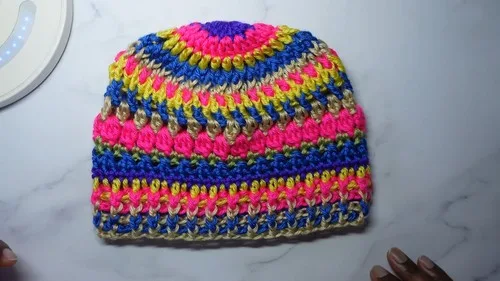
This hat feels like flipping through a box of leftover skeins and deciding none of them get to sit idle anymore. Every round changes its personality a little, moving from smooth double crochet into raised texture and back into something almost woven. It has the restless, playful energy of a mixtape, not a single genre from start to finish.
Set on a shelf or worn out the door, this hat reads as intentional rather than accidental, even though it began as scraps. The mix of textures catches light differently than a flat stockinette-style hat would. It is the kind of piece that makes someone ask what yarn you used, and you get to say all of it.
- Start with a magic ring and build the crown outward through rounds of double crochet worked into chain-one spaces.
- Layer front post double crochet over the lattice you just built to raise texture on the crown.
- Shift into the decrease rounds, working DC2TOG and DC3TOG into the chain spaces to bring the crown inward.
- Move into the body rounds with a single crochet pass that evens out every stitch and space.
- Work the crisscross double crochet round, skipping ahead and circling back to build a woven look.
- Finish the body with another single crochet round followed by a plain double crochet round.
On the desk
- Scrap yarn (any colors you have available)
- Size I (5.5 mm) crochet hook
- Scissors
- Darning or tapestry needle
Stitch shorthand
- ch — chain
- sc — single crochet
- dc — double crochet
- FPdc — front post double crochet
- BPdc — back post double crochet
- SS — slip stitch
- FPTC — front post treble crochet
- DC2TOG — double crochet 2 stitches together (decrease)
- DC3TOG — double crochet 3 stitches together (decrease)
- FPHDC — front post half double crochet
- BPHDC — back post half double crochet
Scrap yarn color burst crochet hat pattern
Crown Rounds
Make a Magic Ring.
- Round 1
Chain 3, work 15 DC into the ring, join with SS into 3rd chain, change color.
- Round 2
Chain 3, 2 DC in every DC around, SS to join, change color.
- Round 3
Chain 4 (counts as CH 3 + CH 1), DC in first DC, (CH 1, DC in next DC) repeat around, end with CH 1, SS to 3rd chain, change color.
- Round 4
Chain 3, DC in CH 1 space, FPDC around next DC, (DC in next CH 1 space, FPDC around next DC) repeat, SS to 3rd chain, change color.
- Round 5
Chain 3, FPDC in first stitch, (DC next, FPDC next) repeat around, SS to 3rd chain, change color.
- Round 6
Chain 3, FPDC around FPDC, (CH 1, skip 1, FPDC next) repeat around. End with CH 1 and FPDC, SS to 3rd chain.
- Round 7
Chain 3, FPDC around FPDC, FPTC around skipped stitch two rounds below, (FPDC next, FPTC below) repeat, SS to join.
- Round 8
Chain 4, skip 1, FPDC next, (CH 1, skip 1, FPDC next) repeat, SS to 3rd chain of CH 4.
Decrease Rounds
- Round 9
Chain 3, DC2TOG in first CH 1 space, (CH 1, skip FPDC, DC2TOG next CH 1 space) repeat, no final chain, SS to join.
- Round 10
Chain 4, DC3TOG in first CH 1 space, (CH 1, DC3TOG next CH 1 space) repeat, end with CH 1, SS to 3rd chain.
Body Rounds
- Round 11
Chain 1, SC in every CH 1 space and stitch, SS to join, change color.
- Round 12
Chain 3, skip 1, DC next, DC back into skipped stitch for Crisscross DC, repeat around, SS to 3rd chain.
- Round 13
Chain 1, SC in every stitch, SS to join.
- Round 14
Chain 3, DC in every SC, SS to join.
Ribbing Rounds
- Round 15
Chain 3, alternate FPDC and BPDC around, starting with FPDC, SS to join.
- Round 16
Chain 3, FPDC around FPDC, BPDC around BPDC, SS to join.
- Round 17
Repeat previous round.
- Round 18
Chain 2, alternate FPHDC and BPHDC around, starting with FPHDC, SS to 2nd chain.
More shots
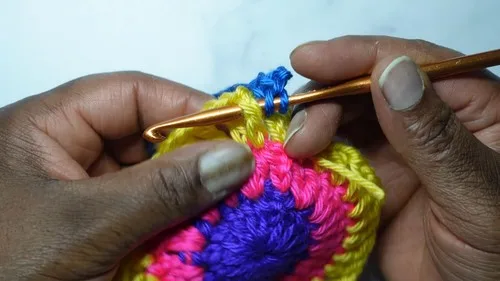
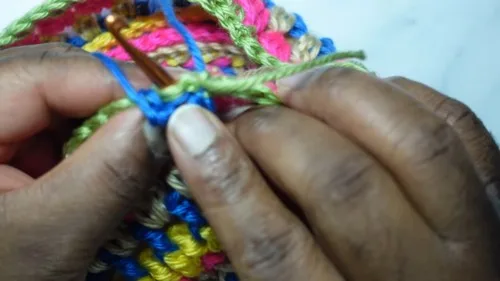
Where it goes
- A daily walking hat that pairs well with a plain wool coat, letting the texture do the talking.
- A gift for a fellow crafter who will appreciate the mix of stitch techniques in a single piece.
- A studio or workshop hat for chilly craft rooms, paired with fingerless mitts in a matching scrap palette.
- A travel layer that packs flat, working with denim jackets or neutral knits when you want a color pop.
Color ideas
- High contrast stripe Alternate a bright and a dark color every time the pattern calls for a color change through the crown rounds, then let the body rounds settle into one steady dark shade before a bright ribbing round.
- Tonal drift Start the crown rounds in your lightest scrap, shift one shade darker with each color change through the decrease rounds, and land on your deepest tone for the ribbing rounds.
Care
Hand wash in cool water if your scrap yarns are wool or a wool blend, since machine washing can felt the texture rounds and flatten the front post detail.
Lay the hat flat to dry on a towel rather than hanging it, so the ribbing rounds keep their stretch instead of sagging.
Store folded flat in a drawer rather than on a hook, which protects the raised front post double crochet texture from getting crushed out of shape.
Assembly
- Step 1 Chain 1 and fasten off.
- Step 2 Weave in all yarn tails securely.
Easy to get wrong
Losing track of chain-one spaces
Mark the first chain-one space of each round with a stitch marker before working the front post double crochet round, since it is easy to work into the wrong spot once the texture builds up. Recount before you join with a slip stitch.
Skipping the wrong stitch in crisscross rounds
Go slowly on the crisscross double crochet round and confirm which stitch you skipped before circling back to it. Working into the skipped stitch out of order distorts the woven look the round is meant to create.
Tight decrease rounds pulling the crown
Keep your tension relaxed through the DC2TOG and DC3TOG rounds so the crown doesn't cup or pucker. If it feels tight, try one hook size looser just for those two rounds.
Between the songs
- The satisfaction here is in the sequence of textures: you start with a plain double crochet crown, move into a chain-space lattice, then layer front post double crochet over that lattice for raised ridges. The decrease rounds compress that same lattice using DC2TOG and DC3TOG, so the shaping logic matches the crown instead of feeling bolted on. Body rounds add a crisscross double crochet section where you deliberately skip and return to stitches, which reads as a woven texture once it is done. Finishing with single crochet and a ribbed edge grounds all that texture in something wearable. It is a genuinely varied stitch dictionary in one small project, so you never repeat the same round twice, and every scrap of yarn gets a distinct home.
Listener questions
Can I use yarns of different weights together in this hat?
You can, but the rounds will look more even if your scraps are close in weight, since the pattern is built on worsted-weight yarn with a size I hook. Mixing thinner and thicker scraps will still work, it just gives each round a slightly different texture.
How many colors do I actually need?
As few as two will work since the pattern calls for a color change at set points rather than a fixed number of colors. Using more scraps just means more changes and more variation round to round.
What if I don't know front post double crochet yet?
It shows up in the crown rounds worked around the post of the previous round's double crochet rather than into the top of the stitch. It's worth practicing a few stitches on a swatch before you start the crown.
Why does the pattern have so many chain-one spaces?
Those chain-one spaces from the crown rounds are exactly where the decrease rounds and the front post texture attach later, so they're doing structural work, not just filling space. Keeping them consistent in size makes the later rounds line up cleanly.
Will the ribbing rounds actually stretch to fit my head?
Ribbing worked in double crochet has some give, especially once it's blocked lightly after finishing. If you want a snugger fit, work your ribbing rounds a touch tighter in tension than the body rounds above it.
Original pattern: https://crocheteverything.com/color-burst-crochet-hat-pattern-made-using-scrap-yarn/
About the Author

Marisol QuinteroWho runs Crochet Obsessed, why a stitch count sits at the end of every round, how a pattern gets written here, and the things this site will never do.
More Patterns
- IntermediateNo. 01

Slouchy everyday beanie worked flat in half double crochet
Crochet beanie pattern for a slouchy everyday look worked flat with hdc rows, then seamed into a soft,…
- IntermediateNo. 02
Crochet amigurumi doll with dress, shoes, and hat
Crochet amigurumi doll pattern with dress, shoes, and hat details for a soft, huggable keepsake you build one…
- IntermediateNo. 03
Chunky moss stitch crochet sweater with raglan-free shoulders
Chunky crochet sweater pattern using moss stitch, worked flat with a 10mm hook for a soft, fast, cool-weather…