- LevelIntermediate
- Time4-6 hours
- Hook2.5 mm
- YarnLace/Sock
About This Pattern
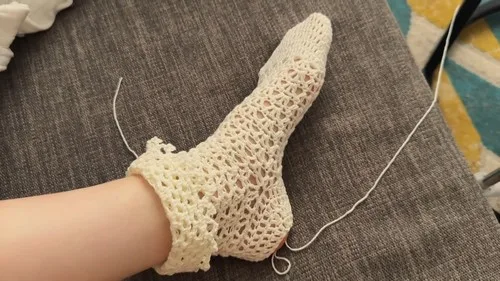
There is something quietly satisfying about a sock that lets light through. This pattern has that open, breezy mood from the first round, built on clusters and chain spaces instead of solid fabric. It feels less like sock-making and more like lacework that happens to fit a foot.
Finished, these socks look more like a textile object than a basic. Set on a windowsill or draped over a chair back, the lace pattern catches shadows the way a curtain does. They read as handmade in the best way, the kind of thing a visitor picks up to ask about.
- Start at the toe with a foundation chain sized to the foot width you are making.
- Build the toe section outward with increase rounds until the stitch count reaches the full total.
- Settle into the Main Lace Pattern, alternating the dc cluster round with the sc and chain round.
- Keep repeating that two-round lace sequence until the foot reaches the length you want.
- Open the heel with a bridge chain that skips across the same number of stitches on the body.
- Work the lace pattern over that bridge to keep the opening consistent with the rest of the sock.
- Shift into the sock leg and cuff rounds to bring the piece up and over the ankle.
- Turn the heel inside out and slip stitch through both layers to close it neatly.
On the desk
- Thin cotton yarn (lace or sock weight, approx. 60–70g)
- 2.5 mm crochet hook
- Scissors and yarn needle
Stitch shorthand
- ch — chain
- dc — double crochet
- sc — single crochet
- sl st — slip stitch
- dc2tog — double crochet 2 together
Airy lace crochet socks with a toe-up construction
Toe Section
Size Adjustment - Narrow Foot: Chain 12 (15 total including first DC).
Size Adjustment - Medium Foot: Chain 16 (19 total including first DC).
Size Adjustment - Wide Foot: Chain 18 (21 total including first DC).
- Round 1
DC in 4th ch from hook; DC across, 4 DC in last stitch; work on other side, 4 DC in first stitch; join with SL ST in 3rd chain.
- Round 2
Ch 3, 1 DC in same st; DC to side, increase in 2nd and 3rd stitches of previous cluster; DC across, 2 DC in last st; join with SL ST.
- Rounds 3–6
Repeat Round 2, adding two increases on each side per row. End with 48–60 total stitches.
Main Lace Pattern
- Round 1
(DC Cluster): Ch 3, 1 DC in same st; skip 3 sts, 3 DC in 4th st, repeat to end; 1 DC in last st; join with SL ST.
- Round 2
(SC & Chain): Ch 1, turn; SC between clusters, Ch 3, SC between next clusters, repeat to end; join with SL ST.Repeat Rows: Alternate Round 1 (DC Cluster) and Round 2 (SC & Chain) until desired foot length. End on a DC Cluster Row.
Heel Opening
- Round 1
Bridge Chain SL ST between DCs, then chain 18–23; skip same number of stitches on body, SL ST to join.
- Round 2
Lace Row Over Bridge Ch 1, SC into same space; Ch 3, skip 1, SC next 2, repeat across bridge; join with SL ST.
Sock Leg & Cuff
Leg: Continue alternating Lace Row 1 and Lace Row 2 (Main Lace Pattern Rounds 1-2) to reach desired height before starting the cuff.
- Round 1
Shells In first arch, SC, Ch 3, SC; Ch 3, SC, Ch 3, SC in next arch, repeat; join with SL ST.
- Round 2
(SC & Chain): Ch 1, turn; SC in arch, Ch 3, SC next arch, repeat.Repeat Round 2 (SC & Chain) three more rows (4 total) before working the Final Edging.
- Round 3
Final Edging - Picot SC in arch, Ch 5, SL ST in 3rd ch, Ch 2, SC in next arch, repeat; join with SL ST.
Finishing the Heel
- Round 1
(DC): Attach yarn at middle of sole, Ch 3; DC around opening; join with SL ST; Ch 3, turn.
- Rounds 2–6
Heel Decrease Rows Make 2 DC2TOG decreases on each side per row (4 total); continue for 5 rows.
More shots
Where it goes
- Layer them under boots on cooler days, paired with a simple wool sweater for texture contrast.
- Wear them barefoot-style indoors over hardwood or tile floors for a bit of warmth without bulk.
- Give them as a thoughtful handmade gift for someone who already owns too many plain socks.
- Pair with cropped pants or wide-leg trousers so the lace cuff peeks out at the ankle.
Color ideas
- Dusty Rose Fade Keep the toe section and heel in a pale blush, then carry a slightly deeper dusty rose through the leg and cuff rounds for gentle contrast.
Care
Hand wash these in cool water with a gentle soap, since fine cotton can lose its crispness in a hot machine cycle.
Lay the socks flat on a towel to dry and gently reshape the lace openings with your fingers while damp.
Store them folded rather than hung, tucked flat in a drawer so the cotton fibers do not stretch out of shape.
Assembly
- Step 1 Cut yarn, turn inside out, slip stitch through both layers to close the heel.
Easy to get wrong
Losing track of toe increases
Mark the first stitch of each round with a scrap of yarn so you can count increases accurately before moving to the next round.
Uneven lace clusters
Check that each dc cluster lands in the chain space of the previous row, not into the sc stitches themselves, to keep the pattern aligned.
Bridge chain too tight or loose
Lay the heel opening flat before joining to confirm the chain matches the width of the skipped stitches on the body.
Between the songs
- The real pleasure here is in the Main Lace Pattern, where dc clusters and chain-3 spaces trade off round after round to build that airy, almost latticed look. Working the toe section toe-up with repeated increase rounds teaches you to read your stitch count by eye, not just by counting. The Heel Opening is a clever bit of construction: a bridge chain closes later with a single seam, instead of fussy short-row shaping. Every part of this pattern rewards attention without demanding perfection, and the fine cotton and 2.5 mm hook keep the whole thing light in your hands from start to finish.
Listener questions
Can I make these in a different size?
Yes, the toe section includes chain counts for narrow, medium, and wide feet. Choose the size adjustment that matches before starting the increase rounds.
Why does the lace pattern alternate two different rounds?
The dc cluster round builds the open lattice look, while the sc and chain round locks those clusters into place. Alternating them is what gives the fabric its airy, structured texture.
Is fine cotton the only yarn that works here?
Cotton gives the lace its crisp drape and good stitch definition at this gauge. A plant-fiber blend in a similar sock or lace weight would behave similarly with the same hook.
How do I know when to stop the Main Lace Pattern?
Keep repeating the two-round sequence until the foot reaches your desired length, then end on a dc cluster row as noted in the pattern. That gives you a clean edge for starting the heel opening.
What if my heel opening does not line up evenly?
Lay the sock flat and compare the bridge chain to the stitches you skipped on the body before joining. Adjusting the chain count slightly at this stage is easier than fixing it after working the lace row over it.
Original pattern: https://crocheteverything.com/how-to-crochet-lace-socks-pattern-with-a-beautiful-airy-design/
About the Author

Marisol QuinteroWho runs Crochet Obsessed, why a stitch count sits at the end of every round, how a pattern gets written here, and the things this site will never do.
More Patterns
- IntermediateNo. 01

Rose Granny Square Tote Crochet Pattern
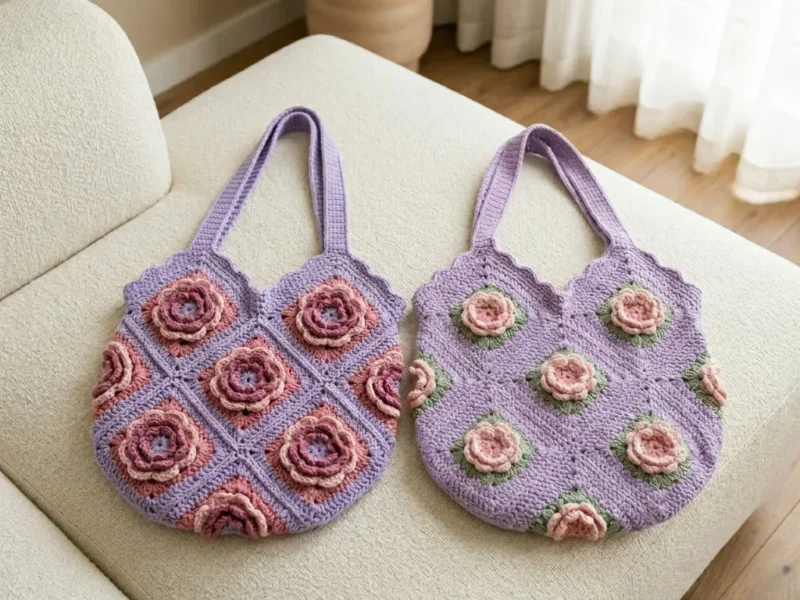
Rose granny square tote crochet pattern made from 18 dimensional rose squares for a sturdy, romantic everyday bag.
- IntermediateNo. 02
Tropical octopus baby blanket crochet pattern with appliqués
Tropical octopus baby blanket crochet pattern: a cream filet base with coral and turquoise octopus appliqués, leaves, and…
- IntermediateNo. 03
Sunny lemon couple amigurumi crochet pattern
Sunny lemon couple amigurumi crochet pattern with embroidered slices and safety eyes for a cheerful handmade shelf pair.