- LevelBeginner
- Time4 hours
- Hook4 mm (G/6)
- YarnWorsted cotton
About This Pattern
On tonight's show: four little records that will not scratch. Each coaster is a flat disc of tight single crochet, and two rounds worked in the back loop only leave raised rings, so the finished piece has grooves you can feel with a thumb. A small mustard label sits in the middle, and the whole set slides into a square sleeve when the table needs clearing.
This is a first-project pattern. If you can chain, single crochet and make an increase, you can finish a coaster in under an hour. The sleeve is plain rows, so it's the part to do with your eyes on the screen.
What Makes It Good
- Cotton takes a wet glass without complaint and dries flat by morning.
- The back-loop grooves are the whole trick. Two rounds, no new stitch to learn, and the record look appears on its own.
- Each coaster uses about 15 g of yarn, so this is a leftover eater as much as a pattern.
- The sleeve doubles as a small gift box when you hand a set to someone.
Materials
Yarn
- WeightWorsted-weight cotton (#4 medium).
- ColorsDark brown for the records, mustard for the labels, orange and teal for the label edges, teal for the sleeve.
- Yardage60 g dark brown, 25 g mustard, 15 g orange, 45 g teal.
Tools and Notions
- Hook4 mm (US G/6). Go down to 3.75 mm if your discs come out loose.
- NotionsTapestry needle, one locking stitch marker, scissors, four pins for the labels.
Gauge: Rounds 1 to 4 of the record measure 5 cm across. Gauge changes the size, not the count, so match it only if you want the sleeve to fit.
Finished size: Each coaster is about 10.5 cm across. The sleeve is 11 cm square.
Makes: Four coasters and one sleeve. Scale up by repeating the record and the label.
Crochet Abbreviations
This pattern is written in US crochet terms.
- MR
- magic ring
- ch
- chain
- sc
- single crochet
- inc
- increase: 2 sc in the same stitch
- sl st
- slip stitch
- BLO
- back loop only
- st(s)
- stitch(es)
- Rnd
- round, worked in a continuous spiral unless told to join
- FO
- fasten off
- *...*
- repeat the part between the stars the number of times given
Vinyl Spin Coasters
Rounds are worked in a spiral. Put the marker in the first stitch of every round and move it up as you go. The number in the teal pill is the total stitches at the end of that round.
The Record
Make 4 · dark brown- Round 16 sc
Make a MR. Work 6 sc into the ring and pull the tail tight to close it.
- Round 212 sc
Inc in each st around.
- Round 318 sc
*Sc 1, inc* six times.
- Round 424 sc
*Sc 2, inc* six times.
- Round 530 sc
Working in BLO for this whole round: *sc 3, inc* six times. The unworked front loops become the first groove ridge.
- Round 636 sc
Back to both loops. *Sc 4, inc* six times.
- Round 742 sc
Working in BLO again: *sc 5, inc* six times. Second groove ridge.
- Round 848 sc
Both loops. *Sc 6, inc* six times. Sl st into the next st to smooth the spiral, then FO and weave in the end.
The Label
Make 4 · mustard, edged in orange or teal- Round 16 sc
With mustard, make a MR and work 6 sc into it. Pull tight.
- Round 212 sc
Inc in each st around.
- Round 318 sc
*Sc 1, inc* six times.
- Round 418 sl st
Change to orange (teal for two of the four labels). Sl st loosely in each st around. FO, leaving a 30 cm tail for sewing.
The Sleeve
Make 2 panels · teal- Row 124 sc
Ch 25. Sc in the 2nd ch from the hook and in each ch across.
- Row 224 sc
Ch 1, turn. Sc in each st across. The ch 1 does not count as a stitch.
- Rows 3 to 2424 sc each row
Repeat Row 2 until the panel is a square, about 11 cm on each side. Count the rows: there should be 24.
- Round 25, edging104 sc
Do not turn. Ch 1, then sc evenly around all four sides of the panel: 24 sc along each of the four edges, working 3 sc into each of the four corner stitches so every corner adds 2 extra. That is 96 plus 8. Sl st to the first sc. FO on the first panel; on the second panel leave a 90 cm tail for joining.
Assembly Instructions
- Wet-block the four records: soak, squeeze in a towel, then press each one flat under a book overnight. Cotton holds the flat shape once it dries.
- Center a label on each record so the label's ring sits inside the first groove. Pin it at four points.
- Sew the label down with the 30 cm tail, catching only the front loop of each label stitch so the seam disappears under the orange edge. Weave in the tail on the back.
- Hold the two sleeve panels wrong sides together. With the 90 cm tail, sc through both layers along the bottom and both sides, one stitch into each stitch of the edging round: 24 up one side, 28 across the bottom with its two corner groups, 24 down the other. Leave the top open. (76 sc)
- Weave in all ends. Slide the four coasters into the sleeve label-side out.
Important Notes
- Cotton has no stretch, so keep every stitch the same size. A tight round after a loose one shows up as a wobble in the groove ring.
- The BLO rounds (5 and 7) are the only rounds that differ. Everything else is plain sc with six increases spread evenly.
- Rounds are spiral. Do not join or chain at the end of Rounds 1 to 7; only Round 8 ends with a sl st.
- The increase of Round 3 sits on the second stitch, Round 4 on the third, and so on. This staggers the increases so the disc stays round instead of hexagonal.
Common Mistakes and Fixes
- The coaster cups like a small bowl.
Too few increases or a very tight hand. Count the increases in the last round; there must be six. If the count is right, go up to a 4.5 mm hook for the outer rounds.
- The coaster ruffles at the edge.
The opposite problem: extra stitches crept in. Recount Round 8. If you have more than 48, you doubled an increase somewhere. Frog back to the last correct count.
- The groove ring spirals instead of circling.
The BLO round started one stitch late or ended one stitch early, so the ridge does not meet itself. Move the marker at the very first stitch of Rounds 5 and 7, and work BLO from that exact stitch to the one before it.
- The label puckers after sewing.
The sewing tension is tighter than the crochet. Loosen the stitches and sew through the front loops only, one stitch of label to one stitch of record.
Variations
- Trivet size. Keep going after Round 8 with the same rhythm: Round 9 is *sc 7, inc* (54), Round 10 is *sc 8, inc* (60), Round 11 is *sc 9, inc* (66) and Round 12 is *sc 10, inc* (72). Add a BLO groove on Rounds 9 and 11. Finished size about 16 cm.
- Two-tone records. Work Rounds 1 to 4 in teal and Rounds 5 to 8 in brown. The color change lands exactly on the first groove.
- Skip the label, keep the ring. Work Round 3 of the label in the same brown as the record and sew it on for a subtle raised center.
- Hanging sleeve. Before the edging round, ch 12 at the top corner of the second panel and sl st back into the same stitch to make a loop for a hook.
Frequently Asked Questions
Can I use acrylic instead of cotton?
You can, and the count stays the same. Acrylic will not block as flat and will hold a warm mug's heat rather than shedding it, so the coaster may curl a little over time. Cotton is the safer choice for anything that touches a glass.
What does "back loop only" mean?
Look at the top of a stitch: it has two strands shaped like a V. The back loop is the strand farther from you. Insert the hook under only that strand, and the front strand stays free as a raised line.
Why is the increase placed differently on each round?
If every increase sits above the last one, the disc grows six straight seams and turns into a hexagon. Shifting the first increase by one stitch each round spreads them out and keeps the edge circular.
How much yarn does one coaster take?
About 15 g of brown for the record and 4 g of mustard plus a meter of orange for the label. The full set with sleeve is under 150 g in total.
Can I wash them?
Yes. Cotton goes through a warm machine wash. Lay the coasters flat to dry and press under a book again if a groove ring has flattened.
About the Author
Marisol QuinteroHost of Crochet Obsessed. Writes every pattern the way she would read it out loud, and keeps a jar of odd cotton ends for coasters exactly like these.
More Patterns
- IntermediateNo. 01

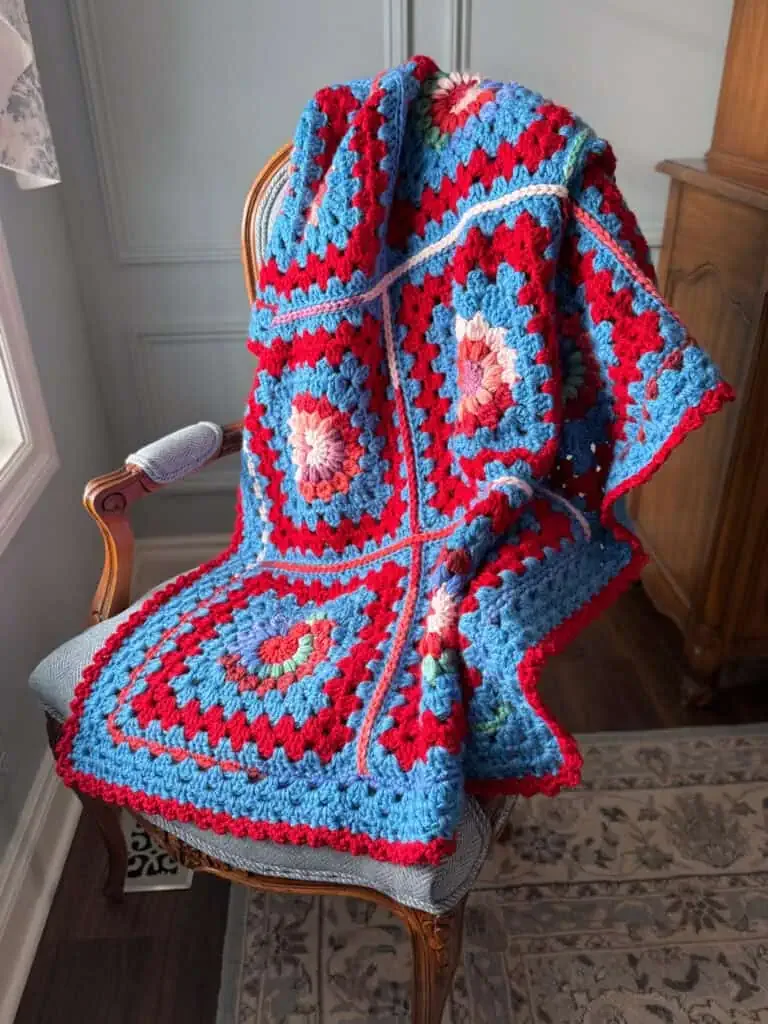
Sunburst Revival Scrap Afghan
Concentric sunbursts worked from the scrap bin, one block at a time.
- IntermediateNo. 02
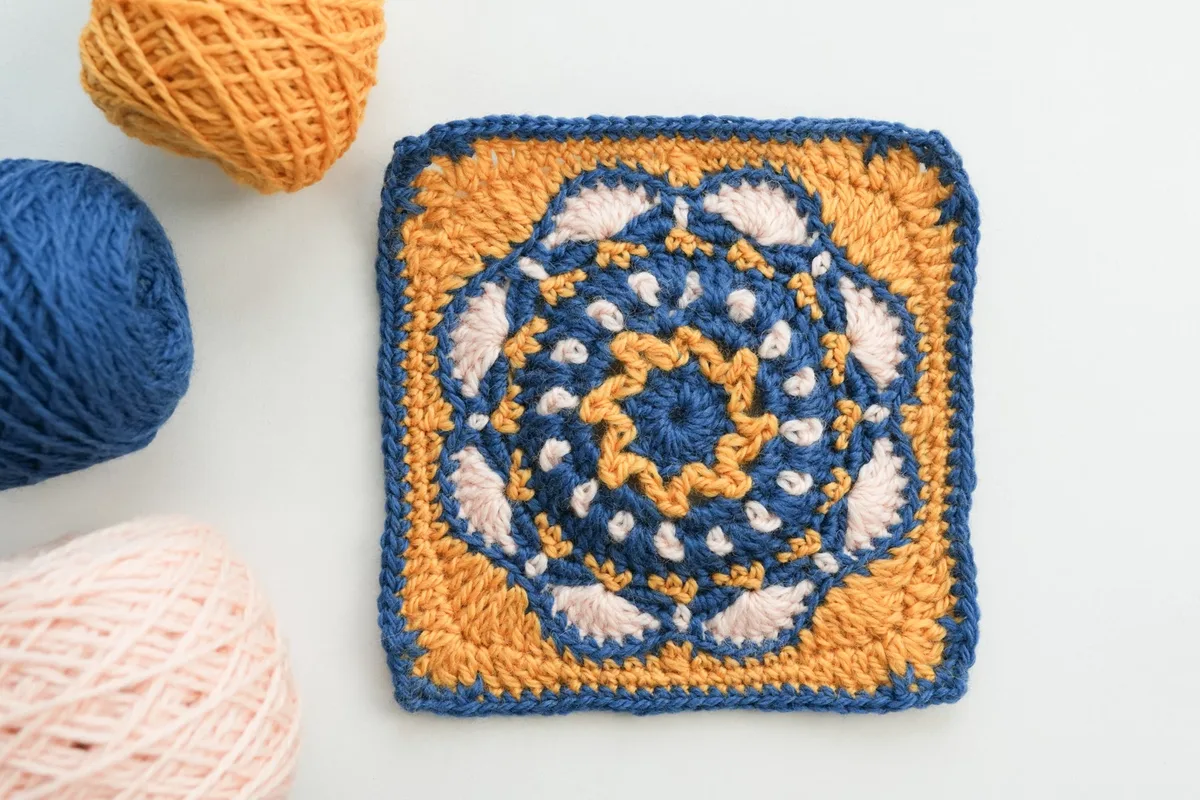
Seventies Unusual Square
An offset motif that reads like a record sleeve from 1974.
- EasyNo. 03
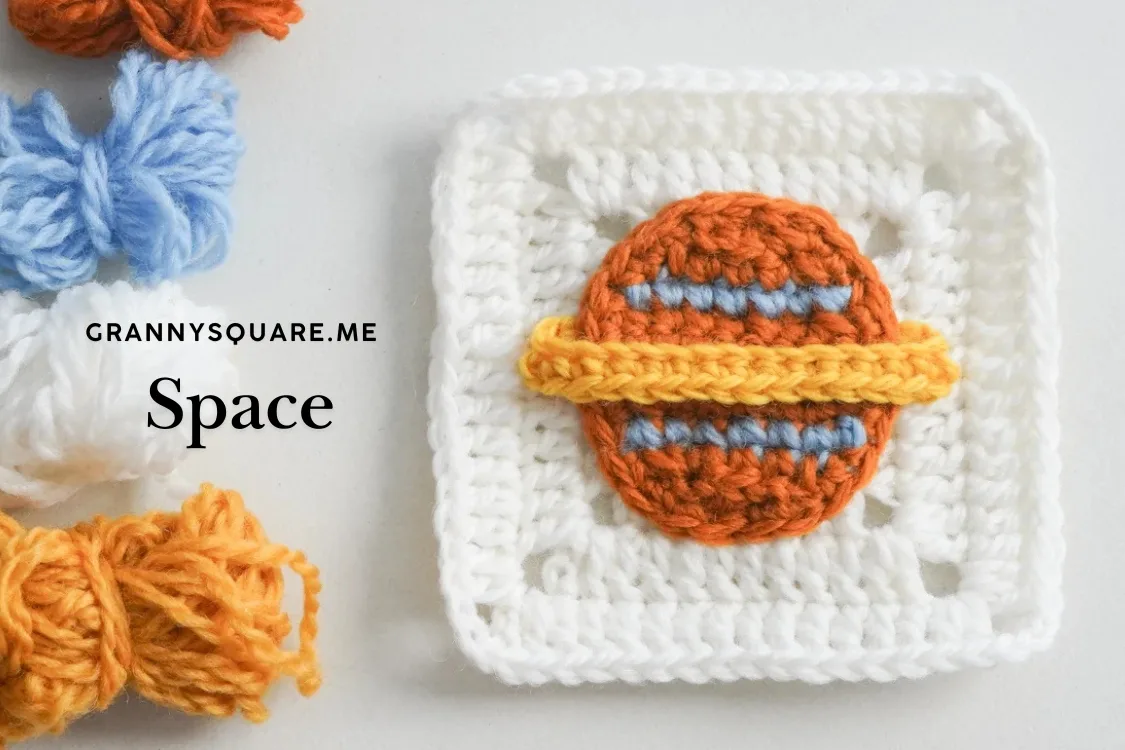
Space Granny Square
A planet and its ring, worked flat and set into a plain block.
Get new patterns by email
One email when a new pattern goes out. No daily noise, no countdown timers.